

No products in the cart.
- Blog
- Grades & specs
- Cutback Bitumen vs Bitumen Emulsion: Why the Industry Is Moving to Water-Based Binders
Cutback Bitumen vs Bitumen Emulsion: Why the Industry Is Moving to Water-Based Binders
Grades & specs

Saniya MirzaBlack Rock Bitumen · Dubai, UAE
4 min read
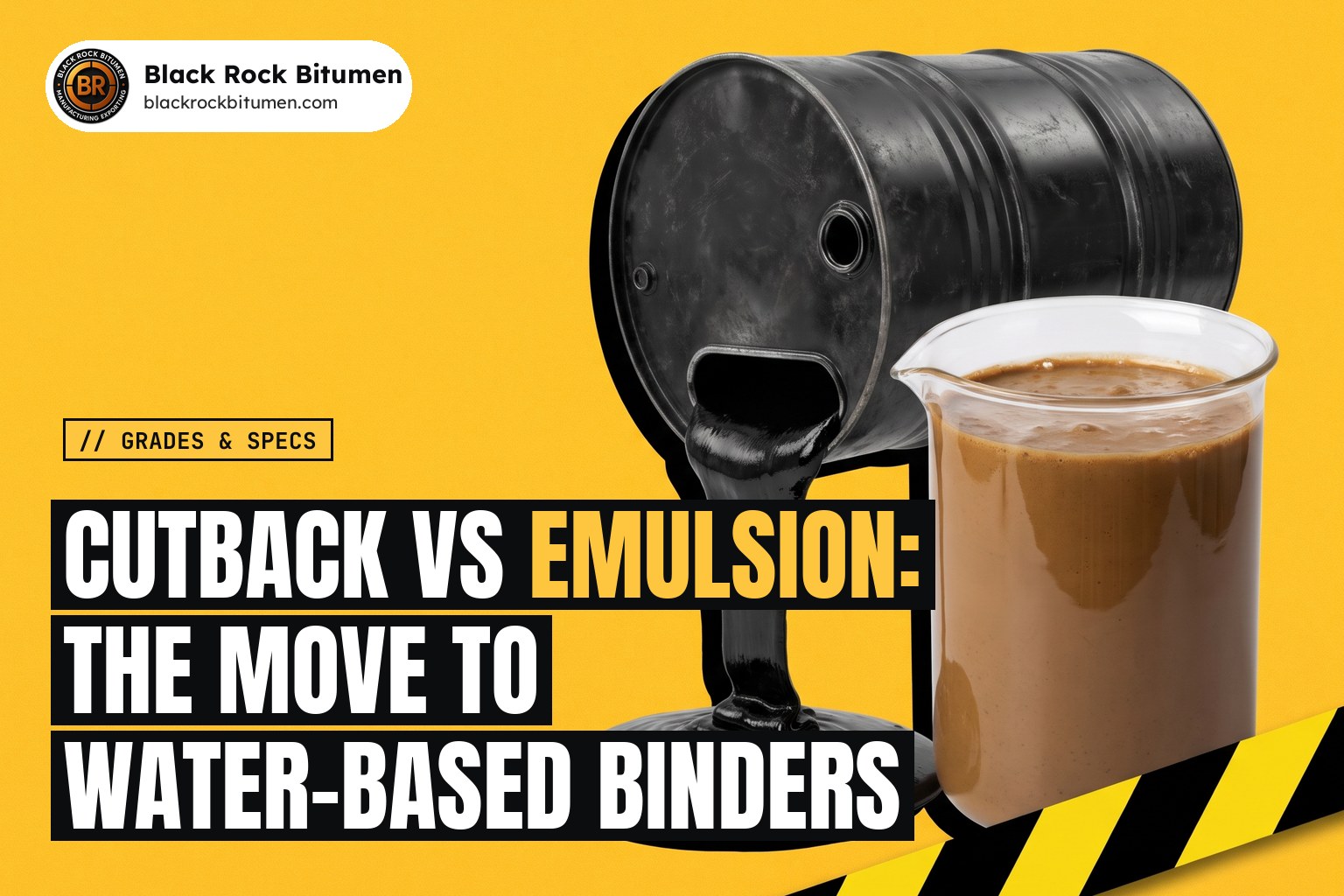
Table of contents
For decades, road construction and maintenance relied heavily on two liquid bitumen products for cold-applied work such as tack coats, prime coats, surface dressing and cold patching: Cutback Bitumen and Bitumen Emulsion.
Both products reduce the high viscosity of standard asphalt binder so it can be applied at room temperature or low temperature, but their underlying chemical mechanisms differ radically. Driven by stringent environmental regulations, occupational health standards and decarbonization mandates, the highway engineering sector is moving away from solvent-based cutbacks in favor of water-based cationic and anionic emulsions.
Understanding the Chemistry: Solvents vs Water Suspension
To apply bitumen without heating it to 150°C to 180°C, the binder’s viscosity must be reduced from thousands of Poise to below 2 Poise.
| Cutback Bitumen | Bitumen Emulsion | |
| How viscosity is reduced | Bitumen is diluted with petroleum solvents (kerosene or diesel) | Bitumen droplets (60% to 70%) are suspended in water (30% to 40%) with an emulsifying agent |
| What happens in the field | Curing: the solvent evaporates into the atmosphere as VOCs | Breaking: the water evaporates and the bitumen coalesces |
1. Cutback Bitumen (Solvent-Based)
Cutback bitumen is produced by blending paving-grade bitumen (such as Pen 60/70) with a volatile petroleum solvent (cutter or flux). The solvent temporarily reduces viscosity; once sprayed onto aggregate or soil, the solvent evaporates into the atmosphere, leaving behind the neat bitumen binder.
Cutbacks are classified by curing speed and cutter volatility:
- Rapid Curing (RC): bitumen fluxed with highly volatile naphtha or gasoline (for example, RC-30, RC-70, RC-250).
- Medium Curing (MC): bitumen fluxed with medium-volatility kerosene (for example, MC-30, MC-70, MC-250).
- Slow Curing (SC): bitumen fluxed with low-volatility gas oil or heavy diesel (for example, SC-70, SC-800).
2. Bitumen Emulsion (Water-Based Suspension)
Bitumen emulsion is a two-phase system created by dispersing microscopic bitumen droplets (1 to 10 microns) in water containing a chemical surfactant (emulsifying agent). The surfactant gives the droplets an electrical charge, creating electrostatic repulsion that prevents them from coalescing during storage.
Emulsions are classified by charge and breaking speed:
- Cationic emulsions (positively charged): designed to adhere strongly to negatively charged siliceous aggregates such as granite, basalt and quartz (for example, K1-40, CRS-2, CSS-1h).
- Anionic emulsions (negatively charged): designed for positively charged limestone and calcareous aggregates (for example, RS-1, SS-1h).
- Setting speeds: Rapid Setting (RS/CRS), Medium Setting (MS/CMS) and Slow Setting (SS/CSS).
Why Environmental Regulations Are Phasing Out Cutback Bitumen
The primary driver behind the regulatory shift away from cutbacks is the environmental and health footprint of volatile organic compounds (VOCs).
1. VOC Emissions and Air Quality
When cutback bitumen cures, most of the petroleum solvent evaporates directly into the atmosphere. Spraying 100 metric tons of MC-30 cutback releases approximately 30 to 40 metric tons of kerosene/naphtha vapours.
These volatile hydrocarbons react with nitrogen oxides (NOx) in sunlight to form ground-level ozone and photochemical smog, contributing significantly to poor air quality.
2. High Carbon Footprint and Resource Waste
Cutbacks use high-value refined petroleum fuels purely as temporary processing carriers. Emulsions use water as the carrier medium, eliminating fossil-fuel evaporation losses and substantially lowering the embodied carbon footprint per square meter of road work.
3. Flammability and On-Site Safety Risks
Rapid-curing cutbacks formulated with naphtha or gasoline have extremely low flashpoints (often below 40°C). Heating cutbacks on job sites presents severe fire hazards, flash explosions and storage tank risks. Bitumen emulsions are water-based, non-flammable and inherently safer to transport, store and apply at ambient temperatures (20°C to 60°C).
4. Occupational Health and Worker Exposure
Field personnel applying solvent-based cutbacks are exposed to high concentrations of aromatic hydrocarbon vapors, which can cause respiratory distress, nausea and long-term neurological risks. Water-based emulsions eliminate solvent vapor exposure during application.
Technical and Operational Comparison
Beyond environmental compliance, bitumen emulsions offer direct engineering advantages over cutbacks in field applications.
| Technical Metric | Cutback Bitumen (e.g., MC-30 / RC-250) | Bitumen Emulsion (e.g., CRS-2 / CSS-1h) |
| Carrier medium | Petroleum solvents (kerosene, gasoline, diesel) | Water plus chemical surfactants |
| VOC / environmental impact | High VOC emissions; contributes to ground-level ozone and smog | Low to negligible VOC emissions |
| Application temperature | Requires heating (60°C to 130°C) depending on grade | Applied cold or at ambient temperature (20°C to 60°C) |
| Damp aggregate tolerance | Poor; moisture blocks solvent penetration and adhesion | Excellent; the water phase carries droplets into damp aggregate pores |
| Fire hazard / flash point | High hazard; low flashpoint (below 40°C for RC) | Non-flammable; no flashpoint risk |
| Storage and energy use | High fuel consumption to heat and maintain tank temperature | Low energy requirement; stable ambient liquid storage |
Key Application Workflows for Bitumen Emulsions
Prime Coat on Unbound Granular Bases (CSS-1 / CSS-1h)
Traditionally, MC-30 cutback was preferred for prime coats because kerosene penetrates deep into crushed rock base courses. Modern slow-setting emulsions (such as CSS-1) formulated with very fine bitumen droplets can penetrate granular base pores effectively without releasing VOCs.
Tack Coat Between Asphalt Layers (K1-40 / CRS-1 / RS-1)
Rapid-setting cationic emulsions are applied between old and new asphalt lifts. The positive charge on the cationic bitumen droplets causes them to break quickly on contact with negatively charged road aggregates, setting in 15 to 30 minutes and establishing a high-shear bond.
Cold Patching and Maintenance Mixes
Emulsion-based cold patches use cationic medium-setting (CMS) or slow-setting (CSS) emulsions mixed with wet aggregates, producing durable repair mixes that can be stored in stockpiles without emitting hazardous vapors.
Procurement and Engineering Takeaway
The transition from solvent-based cutback bitumens to water-based bitumen emulsions is driven by both environmental compliance and engineering advantages. For project owners and EPC contractors, specifying cationic bitumen emulsions (CRS, CMS, CSS) reduces VOC penalties, improves worker safety, allows work on damp aggregates and can lower total project costs through reduced heating energy requirements.
About the author:
Saniya Mirza
Content Writer, Black Rock Bitumen
Saniya Mirza writes the Black Rock Bitumen guides on bitumen grades, testing, storage, shipping and supply, in plain language for buyers, contractors and engineers.