

No products in the cart.
- Blog
- Grades & specs
- Polymer Modified Bitumen (PMB): When Is the Price Premium Worth It?
Polymer Modified Bitumen (PMB): When Is the Price Premium Worth It?
Grades & specs

Saniya MirzaBlack Rock Bitumen · Dubai, UAE
5 min read
Table of contents
As highway networks carry increasing commercial axle loads, higher tire pressures and severe climate extremes, neat (unmodified) bitumen often reaches its physical performance limits. To prevent rutting in peak summer heat and cracking in severe winter cold, road agencies and EPC contractors routinely turn to Polymer Modified Bitumen (PMB).
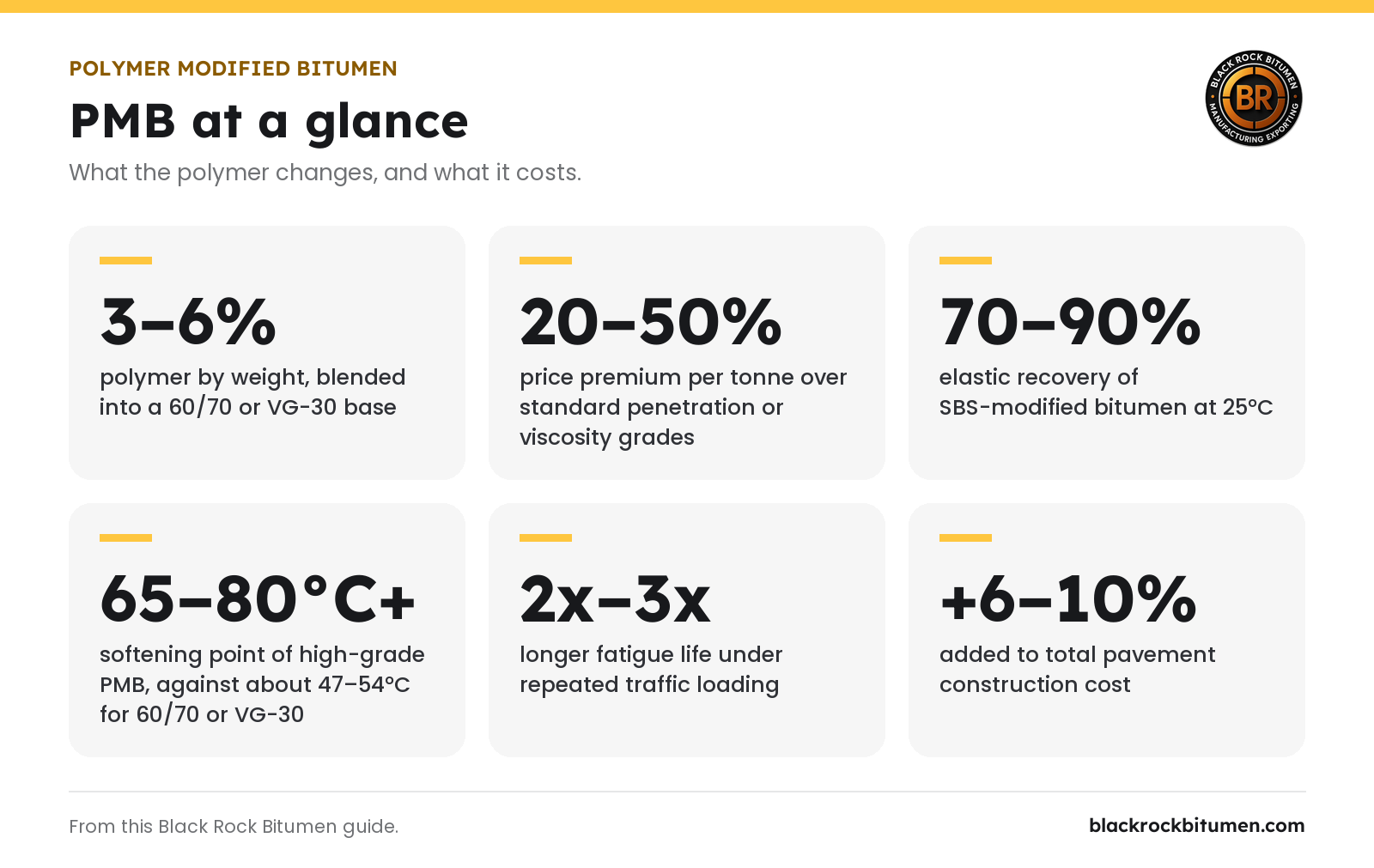
However, PMB carries a 20% to 50% price premium per metric ton over standard penetration or viscosity grade bitumens. For procurement teams, project managers and highway engineers, the central question is clear: when does the engineering performance of PMB justify the higher initial material cost?
What Is Polymer Modified Bitumen (PMB)?
Polymer Modified Bitumen is produced by blending a neat bitumen base (typically Pen 60/70 or VG-30) with an organic polymer compound, usually between 3% and 6% by weight.
The added polymer forms a continuous, cross-linked network within the bitumen matrix, altering its viscoelastic behavior. Unmodified bitumen behaves as a purely viscous liquid at high temperatures and a brittle elastic solid at low temperatures. Polymer modification extends the material’s elastic range across both temperature extremes.
| Binder | Approximate Working Temperature Window | Failure Risk at the Extremes |
| Neat bitumen (for example, 60/70 or VG-30) | -10°C to 60°C | Brittle cracking when cold, plastic rutting when hot |
| Polymer Modified Bitumen (for example, PMB 40 or PG 76-22) | -22°C to 76°C and above | Significantly reduced at both extremes |
Types of Modifiers Used in PMB
Polymer modifiers are divided into categories based on how they alter the bitumen matrix.
| Modifier Class | Common Polymers | Mechanism of Action | Key Benefit |
| Elastomers | Styrene-Butadiene-Styrene (SBS), Styrene-Butadiene Rubber (SBR) | Stretches under load and rapidly recovers its original shape (high elastic recovery) | Superior fatigue resistance, high elastic recovery and excellent low-temperature flexibility |
| Plastomers | Ethylene-Vinyl Acetate (EVA), Polyethylene (PE), Polypropylene (PP) | Forms a rigid physical network that increases binder stiffness and viscosity under load | High resistance to permanent deformation (rutting) at elevated temperatures; high shear strength |
| Crumb Rubber | Recycled Crumb Rubber Modifier (CRMB) | Swells within the light oils of bitumen to form a high-viscosity composite | Cost-effective elastomeric alternative; improved skid resistance and noise reduction |
Key Technical Performance Advantages of PMB
When evaluating laboratory and field performance, PMB outperforms neat bitumen across five critical engineering metrics.
1. Enhanced Elastic Recovery (ASTM D6084)
Standard penetration bitumen shows minimal elastic recovery after stress deformation. SBS-modified bitumen achieves elastic recovery rates of 70% to 90% at 25°C. When a heavy wheel pass flexes the asphalt layer, PMB springs back instead of accumulating permanent plastic strain (rutting).
2. Superior High-Temperature Stiffness and Higher Softening Point
Standard Pen 60/70 or VG-30 bitumens have a softening point of approximately 47°C to 54°C, while high-grade PMBs achieve softening points above 65°C to 80°C. This helps prevent binder bleeding and surface flushing on hot summer days under static or slow-moving traffic.
3. Low-Temperature Ductility and Crack Resistance
Neat bitumens become brittle at sub-zero temperatures, leading to thermal contraction cracking. Polymer modification lowers the glass transition temperature (Tg) of the binder, retaining tensile flexibility down to -20°C or lower.
4. Higher Film Thickness and Anti-Stripping Adhesion
PMBs have higher zero-shear viscosity, allowing asphalt plants to coat aggregates with thicker binder films without the risk of binder runoff or draindown during transport and laydown. Thicker binder films correlate with improved moisture resistance and reduced oxidation aging.
5. Resistance to Fatigue Failure
Under repeated cyclic traffic loading, PMBs absorb dynamic shear energy more efficiently than neat binders, extending structural fatigue life by 2x to 3x in thin and thick asphalt overlays.
Economic and Life-Cycle Cost Analysis (LCCA)
While PMB increases raw material unit price, evaluating road projects through a Life-Cycle Cost Analysis (LCCA) over a 15-to-20-year horizon shows significant net savings under severe operational conditions.
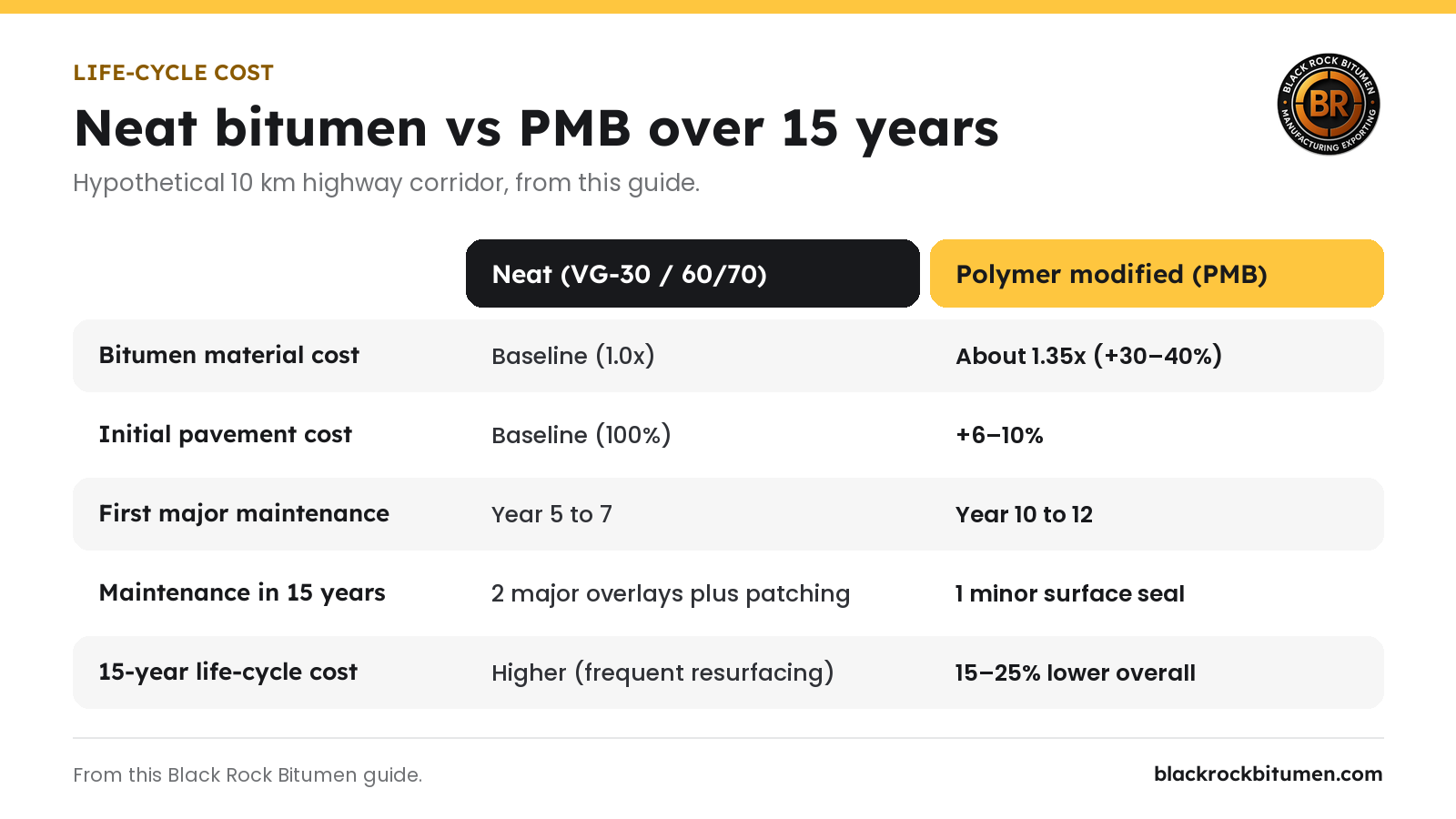
Hypothetical Cost Comparison: 10 km Highway Corridor over 15 Years
| Cost Parameter | Neat Bitumen (VG-30 / 60-70) | Polymer Modified Bitumen (PMB) |
| Initial bitumen material cost | Baseline (1.0x) | +30% to 40% premium (about 1.35x) |
| Total initial pavement CAPEX | Baseline (100%) | +6% to 10% total pavement cost |
| First major maintenance / resurfacing | Year 5 to 7 | Year 10 to 12 |
| 15-year cumulative maintenance operations | 2 major overlays plus patching | 1 minor surface seal |
| 15-year total life-cycle cost | Higher (frequent resurfacing) | 15% to 25% lower overall |
When to Specify PMB vs Unmodified Bitumen
To avoid over-specifying on low-stress projects or under-specifying on high-stress corridors, use the following selection framework.
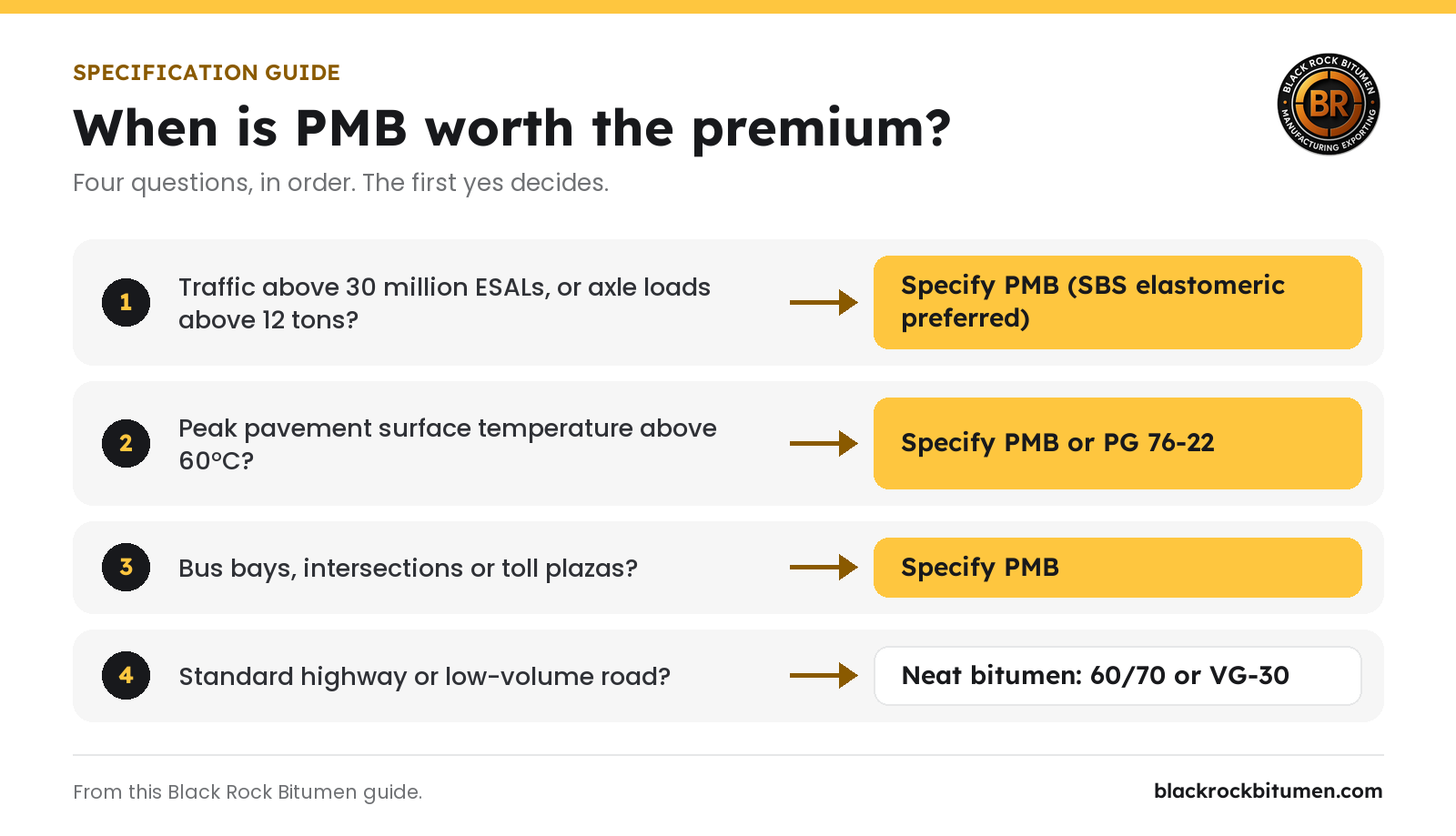
Application Selection Guide
- Is traffic volume above 30 million ESALs, or are axle loads above 12 tons? If yes, specify PMB (SBS elastomeric preferred).
- If no, check peak pavement temperatures. If the peak surface temperature is above 60°C, specify PMB or PG 76-22.
- If peak surface temperature is 60°C or below, check for specialized zones. For bus bays, intersections and toll plazas, specify PMB.
- For standard highways and low-volume roads, use neat bitumen (VG-30 or 60/70).
When the Premium Is Worth It (Specify PMB)
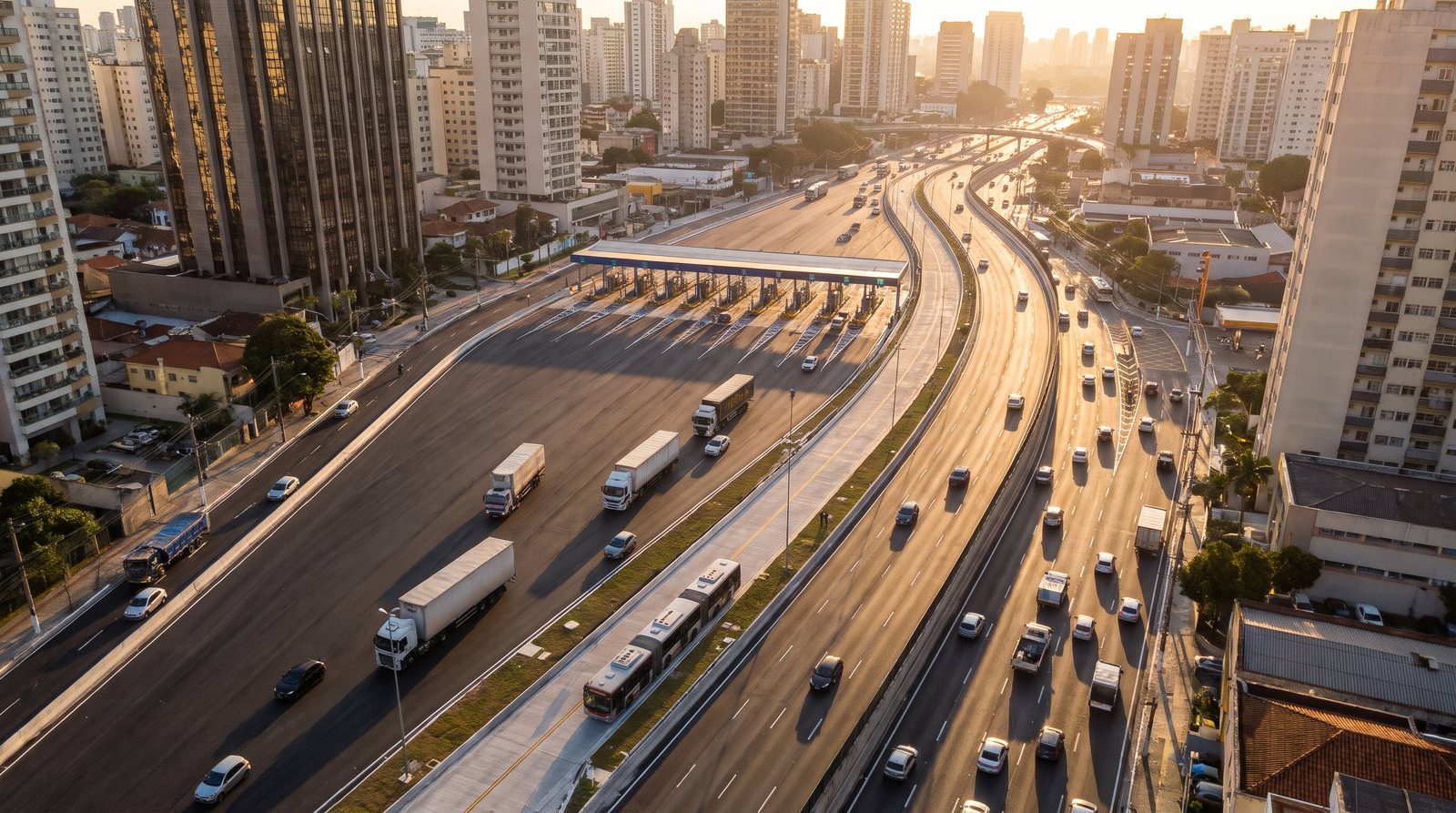
- High-volume expressways and heavy-duty freight corridors: routes carrying high Equivalent Single Axle Loads (ESALs above 30 million).
- Severe mechanical stress areas: toll plaza approach lanes, bus rapid transit (BRT) corridors, urban intersections and roundabouts experiencing heavy stop-and-go static shear forces.
- Airport runways and taxiways: high-impact dynamic loading combined with strict surface integrity requirements (preventing Foreign Object Debris, FOD).
- Extreme climatic zones: regions with wide diurnal or seasonal temperature swings (seasonal delta above 40°C).
- Open-Graded Friction Courses (OGFC) and Stone Matrix Asphalt (SMA): gap-graded mixes that need high binder cohesion and thick binder films to hold coarse aggregate structures without draindown.
When Unmodified Bitumen Is Sufficient (Use Neat Bitumen)
- Low to medium traffic secondary roads: rural routes and residential streets with light axle loads.
- Lower pavement layers (Dense Bituminous Macadam base courses): base layers protected from direct solar heating and surface shear stress, where standard VG-30 or 60/70 bitumen provides adequate structural support.
- Temporary roads and short-term pavements: projects with design lives under 5 years, where long-term fatigue extension provides no financial return.
Key Operational Caveats When Handling PMB
Contractors specifying PMB must account for two critical site handling requirements.
Storage Stability and Phase Separation
PMB polymers can separate from the bitumen matrix during static storage at high temperatures. Tanks require continuous mechanical agitation or recirculation pumps if stored above 160°C for more than 48 hours.
Higher Compaction Temperatures
Due to elevated high-temperature viscosity, PMB asphalt mixes require higher laydown (150°C to 160°C) and compaction (135°C to 145°C) temperatures compared to neat asphalt.
Final Procurement Takeaway
Polymer Modified Bitumen is not a universal substitute for neat bitumen; it is a specialized engineering material. While specifying PMB adds 6% to 10% to initial pavement construction costs, applying it selectively to heavy axle routes, severe climates and high-shear zones can extend pavement fatigue life by 2x to 3x and reduce long-term maintenance cycles, delivering a clear return on investment.
About the author:
Saniya Mirza
Content Writer, Black Rock Bitumen
Saniya Mirza writes the Black Rock Bitumen guides on bitumen grades, testing, storage, shipping and supply, in plain language for buyers, contractors and engineers.