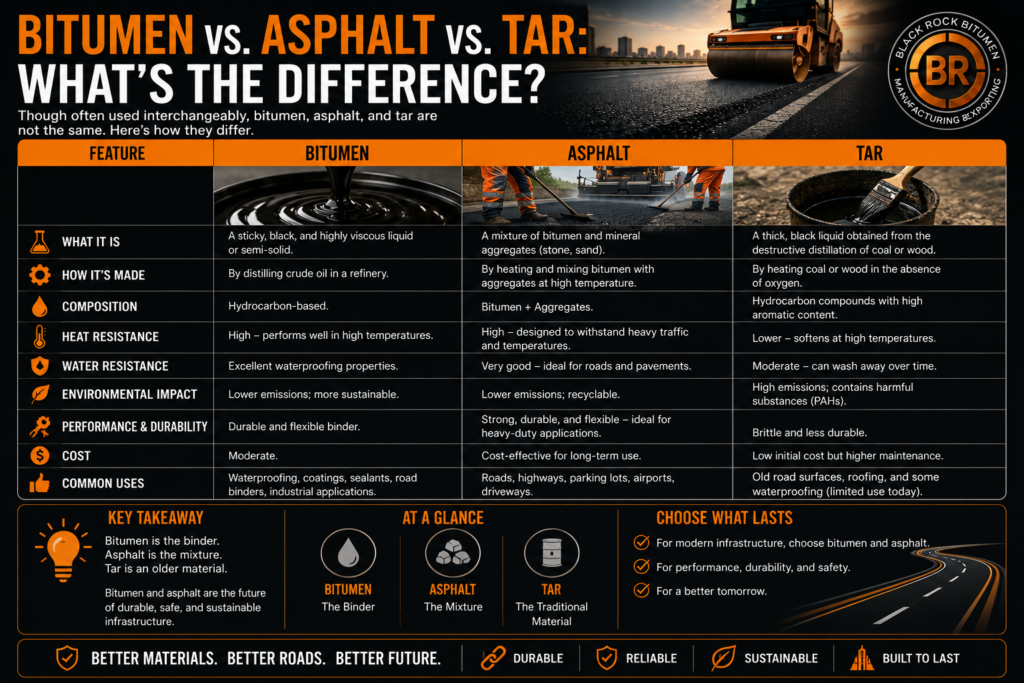
Ask ten people what’s under their car tires on the way to work and you’ll get “asphalt,” “tar,” and “bitumen” thrown around like they’re the same word. For buyers working with Black Rock Bitumen, that distinction matters. In casual conversation, they basically are — nobody gets corrected for saying “tar road” when they mean a paved street. But in a contract, a specification sheet, or a customs declaration, mixing these three up isn’t a language quirk. It’s the kind of mistake that gets a shipment reclassified, a tender misquoted, or a demolition project sent to a hazardous waste facility it never needed to visit.
The confusion runs deeper than most people realize, too. It’s not just that the words get used loosely — the three materials genuinely can look identical to the naked eye, come from completely different raw sources, and carry meaningfully different health and environmental profiles once you dig into the chemistry. Getting this right matters whether you’re drafting a tender, reading an old inspection report, or just trying to understand what’s actually being sold to you.
Here’s what actually separates these three materials — where they come from, what they’re made of, and why one of them fell almost entirely out of use decades ago.
The Short Version
Bitumen is a petroleum-derived binder — the sticky, black substance obtained as a residue when crude oil is distilled, or found naturally in mineral deposits. It’s the “glue” that holds a road together.
Asphalt is the finished composite material: bitumen mixed with mineral aggregate — stone, sand, and gravel. A typical asphalt mix is roughly 95% aggregate and just 5% bitumen binder (Difference Between). Asphalt is what actually gets laid on the road; bitumen is one ingredient in it.
Tar is a different substance entirely, produced through the destructive distillation of organic material — historically coal, sometimes wood — rather than petroleum. Coal tar is a byproduct of coke and coal-gas production, chemically distinct from bitumen despite looking almost identical to the untrained eye (civiljungles.com).
Put simply: bitumen is an ingredient, asphalt is the finished product made from that ingredient, and tar is a different ingredient entirely that used to compete with bitumen but has largely been phased out.
Alt text: Comparison of bitumen, asphalt and tar showing their different sources, what each material is, and how each is used today.
Side by Side
| Bitumen | Asphalt | Tar | |
| Source | Crude petroleum distillation, or natural deposits | Bitumen + mineral aggregate | Destructive distillation of coal or wood |
| What it is | A binder (ingredient) | A composite material (finished product) | A binder (ingredient), now largely obsolete |
| Typical composition | ~87% carbon, ~11% hydrogen, ~2% oxygen; sulphur can vary up to ~6% | ~95% aggregate, ~5% bitumen | Hydrocarbons plus free carbon, high PAH content |
| Common use today | Road binder, roofing, waterproofing | Road and pavement surfacing | Wood preservation (creosote), rarely in new paving |
| Solubility | Soluble in carbon disulfide; trichloroethylene is used for solubility testing under EN 12592 / ASTM D2042 | N/A (composite) | Distinguishable via lab testing, not visually |
Why the Confusion Exists in the First Place
The mix-up isn’t random — it’s historical. Before petroleum bitumen became widely available and standardized, coal tar was the go-to road binder. It was abundant, cheap, and a convenient use for a byproduct of gasworks and steel manufacturing that would otherwise go to waste. During the early and mid-20th century, tar-bound roads were genuinely common, and “tar road” was an accurate description, not just a casual phrase.
That’s also where terms like “tarmac” come from — a name that stuck around in everyday language long after the industry itself moved almost entirely to petroleum-based bitumen and asphalt. The words never caught up to the material change, which is exactly why a term that was accurate a century ago is now a source of confusion on modern job sites and contracts.
The Difference That Actually Matters: Health and Environmental Risk
This is where the distinction stops being academic. Coal tar carries a fundamentally different, and significantly worse, health and environmental profile than bitumen — and the data on this is not close.
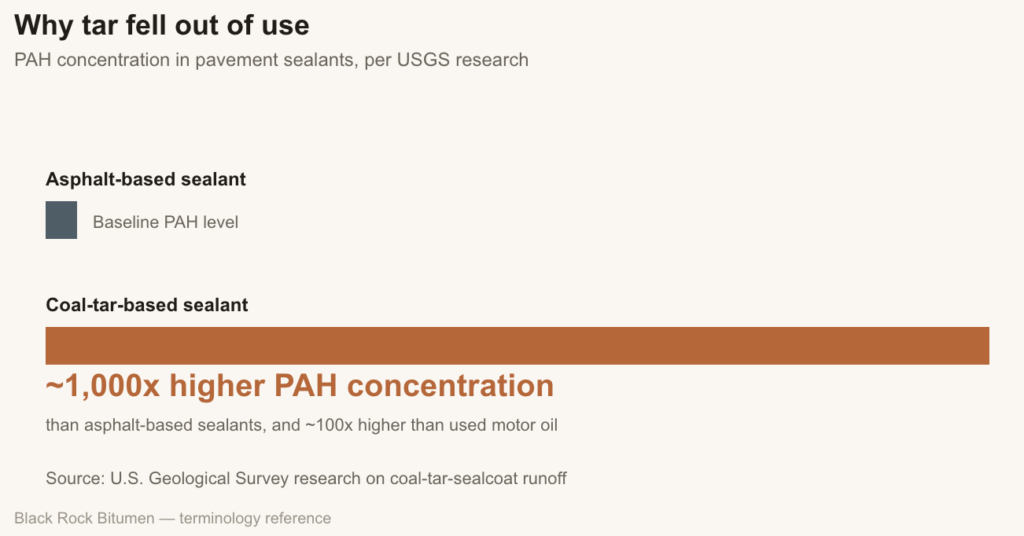
Research from the United States Geological Survey found that coal-tar-based pavement sealants contain PAH (polycyclic aromatic hydrocarbon) concentrations roughly 1,000 times higher than asphalt-based sealants, and 100 times higher than used motor oil (USGS).
Alt text: USGS-based comparison showing coal-tar-based sealant has approximately 1,000 times higher PAH concentration than asphalt-based sealant.
Several PAHs found in coal tar are classified as probable human carcinogens, and coal-tar pitch is classified by the International Agency for Research on Cancer (IARC) as carcinogenic to humans (Group 1). Bitumen and asphalt-based products carry meaningfully lower PAH concentrations by comparison, which is the core reason most regions have moved away from tar-bound paving and sealants entirely — this isn’t a marketing preference, it’s a measurable difference in what ends up in the air, the water, and the dust in people’s homes.
Why This Matters for Contracts, Not Just Chemistry
The historical overlap between these terms creates a real, practical risk on live projects — not just a vocabulary problem.
Consider a scenario that plays out more often than buyers expect: a municipality tenders a project described as “tar resurfacing,” using the old colloquial term out of habit. A contractor prices the job assuming a standard modern bitumen mix. Later, testing on the existing road layers reveals the original surface actually contains coal tar from decades earlier — material that may require specialist handling and disposal under applicable regulations, at a cost nobody budgeted for. On a large resurfacing or demolition project, testing, removal, transport, and specialist disposal can turn that terminology mistake into a five-figure or even six-figure cost exposure. Visual inspection alone can’t reliably tell old coal tar apart from bitumen in an aged asphalt layer — it takes laboratory testing to measure PAH levels and confirm binder composition before a resurfacing or demolition project moves forward.
The lesson for buyers and contractors: when a spec, tender, or contract uses the word “tar,” don’t assume it means what “bitumen” or “asphalt” would mean today. Confirm the actual material, especially on any resurfacing or demolition project touching pavement laid before petroleum bitumen became the regional standard.
What This Means for Sourcing Today
For virtually every modern paving, roofing, and waterproofing project, bitumen — not coal tar — is the material actually in circulation. It’s what shows up on technical data sheets, what gets graded under ASTM and EN penetration and performance systems, and what’s specified in essentially every current construction standard across Africa, South America, and Southeast Asia. Coal tar’s role today is largely limited to legacy infrastructure still being identified and removed, and a narrow set of niche applications like creosote wood preservation.
That said, “legacy infrastructure” isn’t a purely academic footnote in fast-growing markets. Roads built decades ago, before petroleum bitumen became the regional default, still exist under newer surface layers in plenty of cities — and resurfacing or widening projects on those older corridors can genuinely run into coal tar in the substrate. It’s worth treating any deep resurfacing or full-depth reconstruction on an older route as a candidate for testing, rather than assuming every layer under the current surface is standard bitumen just because everything laid in the last few decades has been.
If you’re sourcing material for a new project, “bitumen” and “asphalt binder” are the terms to use in your paperwork — not “tar,” even if that’s the word a client or a site foreman uses out of habit. Getting that terminology right up front avoids the exact kind of contract confusion described above.
Frequently Asked Questions
Is bitumen the same thing as tar? No. Bitumen is petroleum-derived, while tar is produced from the destructive distillation of coal or wood. They can look nearly identical, but they’re chemically distinct, and tar carries a significantly higher concentration of carcinogenic PAHs.
Why do people still call roads “tar roads” if they’re actually made with bitumen? It’s a holdover from history. Coal tar was the common road binder before petroleum bitumen became standardized in the early-to-mid 20th century, and the terminology never fully caught up with the shift in materials.
Is asphalt the same as bitumen? No. Bitumen is the binder — one ingredient. Asphalt is the finished composite material, typically around 95% mineral aggregate and 5% bitumen binder.
Can you tell tar and bitumen apart just by looking at them? No. Visual inspection alone can’t reliably distinguish the two, especially in old, aged pavement layers. Laboratory testing for PAH content and binder composition is required for a reliable determination.
The Bottom Line
Bitumen, asphalt, and tar get used interchangeably in everyday speech, but they’re not the same thing, and the differences aren’t just technical trivia. Bitumen is the modern, petroleum-derived binder behind essentially all current paving, roofing, and waterproofing work. Asphalt is the finished product made from it. Tar is an older, chemically distinct material that’s now avoided in new construction because of its significantly higher health and environmental risk. Getting the terminology right protects your contracts as much as it protects the people working on the site.
Black Rock BitumenPenetration Grade BitumenOxidized Bitumen why Dubai has become a strategic hub for bitumen exports to Africa and Asia how inconsistent bitumen quality impacts road lifespan and maintenance budgets covers the downstream cost of getting this wrong.