There is a point in almost every road project where the conversation changes from “Which bitumen grade do we need?” to a more expensive question: “Do we actually need Polymer Modified Bitumen?”
That second question matters because PMB costs more than conventional paving bitumen. But price alone is a poor way to make the decision. A standard binder can deliver excellent performance when the grade matches the pavement’s climate and traffic. PMB becomes valuable when the road is being asked to handle conditions that push conventional bitumen closer to its limits.
For buyers across Africa, South America and Southeast Asia, that distinction matters. Hot pavement temperatures, heavy freight corridors, stop-start urban traffic and rapid infrastructure growth can all increase the stress placed on a binder. Black Rock Bitumen’s climate guidance makes the same point: average annual air temperature is not enough. Peak pavement temperature, moisture exposure and traffic loading need to be considered together.
So, which one should you use? The short answer is: standard bitumen when the pavement’s climate and traffic are within the selected grade’s performance range; PMB when traffic, temperature or concentrated loading justify the extra performance.
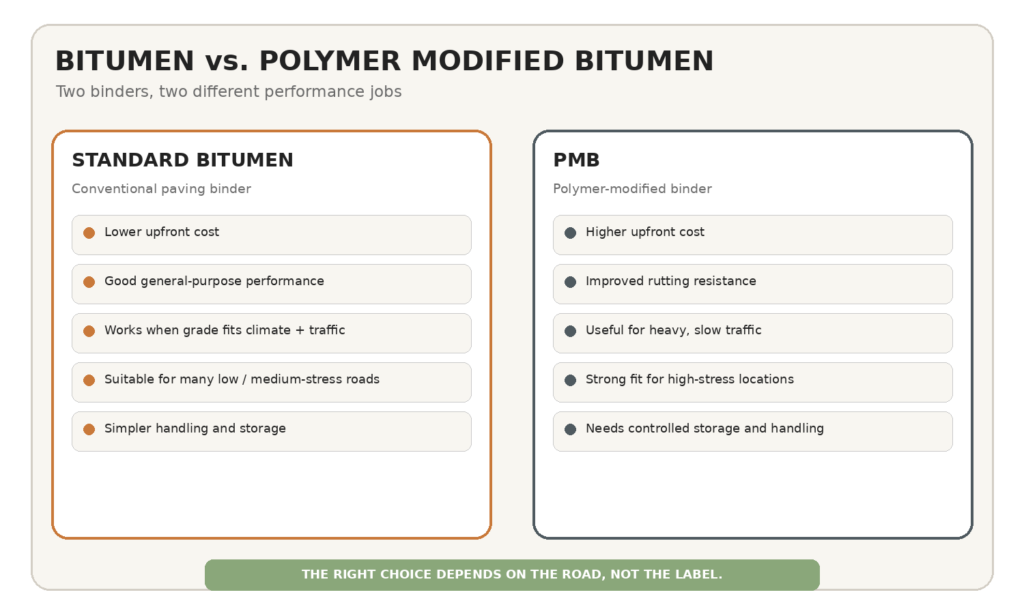
Alt text: Side-by-side comparison of standard bitumen and Polymer Modified Bitumen, showing differences in upfront cost, rutting resistance, traffic suitability, temperature performance and typical applications.
What Is Standard Bitumen?
Standard paving-grade bitumen is the conventional binder used to hold asphalt aggregate together and provide the flexible properties required by the pavement. It is supplied under systems such as penetration grade, viscosity grade and Performance Grade, depending on the project and governing standard.
For example, Bitumen 60/70 is a conventional paving grade used where its performance range matches the project requirements.
The important word is “matches.” Standard bitumen is not a low-quality version of PMB. It is simply unmodified. If a road has moderate traffic, an appropriate climate and a sound pavement design, paying for polymer modification may provide little additional value.
That is why conventional bitumen remains a sensible choice for many rural roads, secondary routes and general paving applications. The grade still needs to be selected properly; the cheapest grade is not automatically the right grade.
What Is Polymer Modified Bitumen?
Polymer Modified Bitumen, or PMB, is conventional bitumen modified with polymers to change its behaviour under temperature and mechanical stress. SBS is one of the most widely used polymer systems in PMB.
The purpose is not to make the binder “premium” for the sake of it. The purpose is to improve performance where the pavement is exposed to conditions that can cause conventional binders to soften, deform or crack sooner than expected.
The Federal Highway Administration identifies polymer-modified binders as useful for demanding applications including high-volume roads, heavy-truck routes, intersections and extreme climates. The important point is that the binder is being matched to a performance problem, not selected simply because it is a more advanced product.
See Black Rock Bitumen’s PMB 25/55-65 product page for an example of a defined PMB specification.
What Actually Changes When You Add Polymer?
A conventional binder becomes softer as temperature rises. That is normal bitumen behaviour. The engineering challenge is keeping the binder stiff enough at high pavement temperatures to resist deformation while retaining enough flexibility at lower temperatures.
Polymer modification changes the binder’s rheological behaviour. Depending on the formulation, PMB can improve resistance to rutting and deformation and can also improve fatigue and low-temperature performance.
FHWA research has found performance benefits from polymer-modified binders in demanding pavement applications, while Eurobitume’s recent work emphasises that the actual PMB formulation matters: polymer type, polymer content and base-binder chemistry can all influence performance.
For the wider performance-grade approach, see Performance Grade Bitumen.
The Biggest Difference: Rutting
Rutting is one of the clearest reasons a project moves from conventional bitumen toward PMB. It happens when repeated traffic loads permanently deform the pavement, leaving depressions in the wheel paths.
The risk rises when several factors occur together: high pavement temperatures, heavy axle loads, slow-moving traffic, braking, acceleration and repeated loading in the same location.
A road can therefore perform perfectly well with conventional bitumen along its main carriageway and still develop problems at an intersection. Trucks slow down. Buses stop. Vehicles turn and accelerate. The same few square metres of pavement receive concentrated stress again and again.
That is where PMB can earn its higher price. It is not necessarily needed everywhere; it may be most valuable exactly where the pavement is being stressed the hardest.
Climate Changes the Decision
“Is this country hot?” is not enough information to choose a binder. The more useful question is: “What temperature will the pavement actually reach, and what traffic will be acting on it at that temperature?”
Research discussed in Black Rock Bitumen’s climate-grade guide shows why this matters. In tropical Indonesia, pavement surface temperatures have been measured at 45.65°C during sunny periods even while air temperatures remained below 37°C. Other hot Southeast Asian conditions have produced substantially higher pavement temperatures. The pavement, not the weather station reading alone, is what the binder experiences.
Rainfall adds another layer, but it should not be confused with binder grade selection. Moisture damage is often an adhesion and drainage problem. A correctly selected binder can still suffer stripping if water management and aggregate-binder adhesion are ignored.
| Condition | Typical implication | What to consider |
| Hot, arid climate | Higher softening/rutting risk | Harder grade or PMB depending on traffic |
| Hot, humid tropical climate | Heat + moisture exposure | Correct binder + anti-stripping/drainage measures |
| Variable/highland climate | Large temperature swings | PMB or suitable wide-range PG |
| Moderate climate | Lower thermal stress | Standard grade may be sufficient |
Standard Bitumen vs. PMB: What Changes?
The easiest way to understand the decision is to compare the two binders against the conditions that actually drive pavement failure.
| Factor | Standard Bitumen | PMB |
| Upfront cost | Lower | Higher |
| General road paving | Usually sufficient when correctly specified | Suitable, but may be unnecessary |
| Rutting resistance | Grade dependent | Generally higher |
| Heavy truck loading | Good with the right grade | Strong candidate |
| Stop-start traffic | Moderate to good | Often preferred |
| Temperature range | Grade dependent | Can provide a wider performance window |
| Rural / secondary roads | Usually sufficient | Often excessive |
| Intersections / loading zones | Project dependent | Often preferred |
| Airport / industrial pavements | Project dependent | Often preferred |
Is PMB Worth the Extra Cost?
PMB costs more per tonne. That is the part procurement teams see first. But the more useful calculation is what the extra binder performance could save over the life of the pavement.
Binder is only one component of an asphalt mix, so a higher binder price does not translate directly into the same percentage increase in total pavement cost. If PMB delays rutting, fatigue damage or major resurfacing, the initial premium may be small compared with the cost of repairing a road earlier than planned.
The reverse is also true. If the road is lightly trafficked and a conventional grade already satisfies the engineering specification, PMB can be an unnecessary expense.
This is why lifecycle cost is a better comparison than purchase price. Ask what the additional binder performance is expected to achieve, then compare that benefit with the premium.
Current market research also points to continued growth in PMB demand. Grand View Research estimates the global polymer-modified bitumen market was about USD 12.9 billion in 2023 and forecasts it to reach roughly USD 17.0 billion by 2030, with road construction identified as the leading application. Market estimates vary between research firms, so the useful takeaway is the direction of travel: performance-focused binders are becoming more important where infrastructure owners are targeting durability and heavy-load performance.
Where PMB Makes the Most Sense
1. Heavy Freight Corridors
If a road carries a high proportion of heavy trucks, repeated axle loading can make rutting and deformation much more important. When those loads are combined with high pavement temperatures, PMB becomes a strong candidate.
2. Intersections and Roundabouts
Braking, turning, stopping and acceleration concentrate stress in relatively small areas. These locations can deteriorate before the straight sections of the same road, which is why a higher-performance binder may be justified there.
3. Airport Pavements
Aircraft and service vehicles create demanding loading conditions. Runways, aprons and other high-load areas should be specified according to the project’s engineering requirements, with PMB considered where the loading and temperature conditions justify it.
4. Ports and Industrial Yards
Container terminals, logistics yards and industrial pavements can see repeated concentrated loading from trucks and heavy equipment. The additional deformation resistance of PMB can be valuable in these environments.
5. Extreme or Variable Temperatures
Where a pavement has to handle substantial temperature variation, PMB can provide a wider useful performance window. The exact grade still needs to be selected against the governing specification.
When Standard Bitumen Is the Better Choice
PMB is not automatically the answer. Standard bitumen may be the better technical and economic choice when traffic is relatively light, the climate is within the selected grade’s performance range, and the pavement is not exposed to concentrated or unusual loading.
There is also no reason to specify PMB simply because a supplier offers it. The project specification should determine what performance is required.
For procurement teams working from ASTM, EN or other tender requirements, Bitumen Grades & Standards for Infrastructure Tenders provides useful context for comparing grade systems and specifications.
Alt text: Five-step PMB decision path showing climate, traffic, high-stress locations, project specification and lifecycle cost as the main factors in deciding whether Polymer Modified Bitumen is justified.
A Simple Decision Path
1. Pull peak pavement-temperature data. Do not rely only on average annual air temperature.
2. Check traffic and axle loading. Identify heavy trucks, slow-moving traffic and repeated loading.
3. Identify high-stress locations. Look specifically at intersections, ramps, bus stops, roundabouts, port entrances and loading zones.
4. Match the binder to the governing specification. Confirm the required ASTM, EN, AASHTO or local standard.
5. Compare lifecycle cost. Weigh the PMB premium against the expected maintenance and service-life benefit.
Don’t Forget Storage and Handling
Choosing PMB does not end the technical discussion. Storage and handling matter because modified binders need appropriate temperature control and circulation to maintain uniformity.
Black Rock Bitumen’s storage guidance specifically flags scheduled or continuous agitation for PMB and warns against treating circulation as optional. The same guide emphasises that storage temperatures should be product-specific and that prolonged high-temperature storage can accelerate ageing.
For the full handling framework, see Black Rock Bitumen’s Bitumen Storage, Handling & Transport Standards.
What the Market Trend Tells Us
The direction of the market is increasingly toward performance-based pavement materials. Eurobitume’s 2026 life-cycle assessment work on SBS-based PMB examines representative standard- and high-performance formulations and reflects the industry’s growing focus on durability and whole-life performance.
That does not mean every road should use PMB. It means procurement decisions are increasingly being evaluated on what the pavement needs to deliver over its service life rather than on the lowest binder price alone.
For buyers in Africa, South America and Southeast Asia, that shift is especially relevant on major freight corridors, urban routes and infrastructure projects where traffic loads are increasing and pavement temperatures can be demanding.
Frequently Asked Questions
Is PMB always better than standard bitumen? No. PMB is designed for more demanding conditions. Standard bitumen can be the better choice when the selected grade already meets the project’s climate, traffic and performance requirements.
Is PMB worth the extra cost? It can be on high-traffic roads, heavily loaded sections, extreme climates and long-life pavement projects. The decision should be based on lifecycle cost rather than binder price alone.
Does PMB prevent rutting? PMB can improve resistance to deformation, but it does not make a pavement immune to failure. Aggregate quality, mix design, layer thickness, drainage, compaction and construction quality still matter.
Is PMB suitable for tropical climates? Yes, particularly where tropical heat is combined with heavy traffic or concentrated pavement stress. Moisture protection still requires appropriate aggregate-binder adhesion and drainage measures.
Can a project use both standard bitumen and PMB? Yes, where the pavement design and specification permit it. High-stress locations can be treated differently from lower-stress sections.
Does PMB require special storage? PMB generally requires more careful temperature and circulation management than conventional paving bitumen. Exact requirements should follow the product specification and supplier guidance.
The Bottom Line
Standard bitumen isn’t outdated. PMB isn’t automatically better. The right choice depends on what the pavement is going to survive.
For moderate traffic and normal service conditions, a correctly selected conventional bitumen grade can provide strong performance at a lower upfront cost. For heavy freight corridors, intersections, airports, industrial pavements, extreme heat and other high-stress applications, PMB can provide the additional deformation resistance and durability performance needed to justify its premium.
The smartest approach is simple: start with climate, add traffic, identify the high-stress locations, check the project specification, and then compare lifecycle cost.
The goal isn’t to buy the most advanced binder. It’s to buy the binder that gives the road the performance it actually needs.

Content Writer, Global Bitumen Supply & Market Insights, Black Rock Bitumen
Farheen Fatima is an infrastructure materials writer specializing in bitumen supply, asphalt technology, and global road construction. He shares practical insights on bitumen grades, supplier evaluation, and international standards to help contractors and project teams make informed procurement decisions.