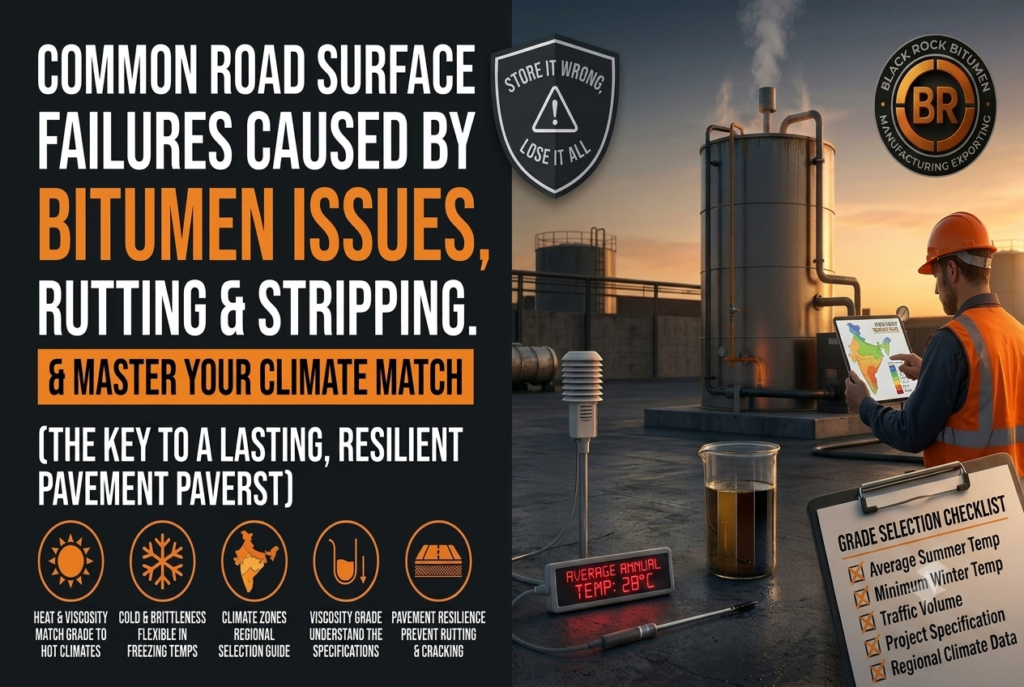
When an asphalt road starts failing, the first thing people notice is usually the surface: a shiny black film, channels in the wheel paths, loose aggregate, cracking or potholes.
But the surface symptom does not always tell you the root cause.
Three failures that regularly get discussed in relation to bitumen and asphalt mixtures are **bleeding, rutting and stripping**. They can be influenced by binder selection, binder content, air voids, aggregate properties, moisture, traffic, construction quality and the underlying pavement structure.
That last point matters. A road should not automatically be blamed on “bad bitumen” just because a surface defect appears. FHWA notes that many visible pavement distresses can originate in underlying unbound layers or subgrade rather than the asphalt surface itself. citeturn0search6turn0search26
So the goal of this guide is not simply to list three failures. It is to explain what they look like, how bitumen can contribute, what else can cause them, and why correct diagnosis should come before treatment.
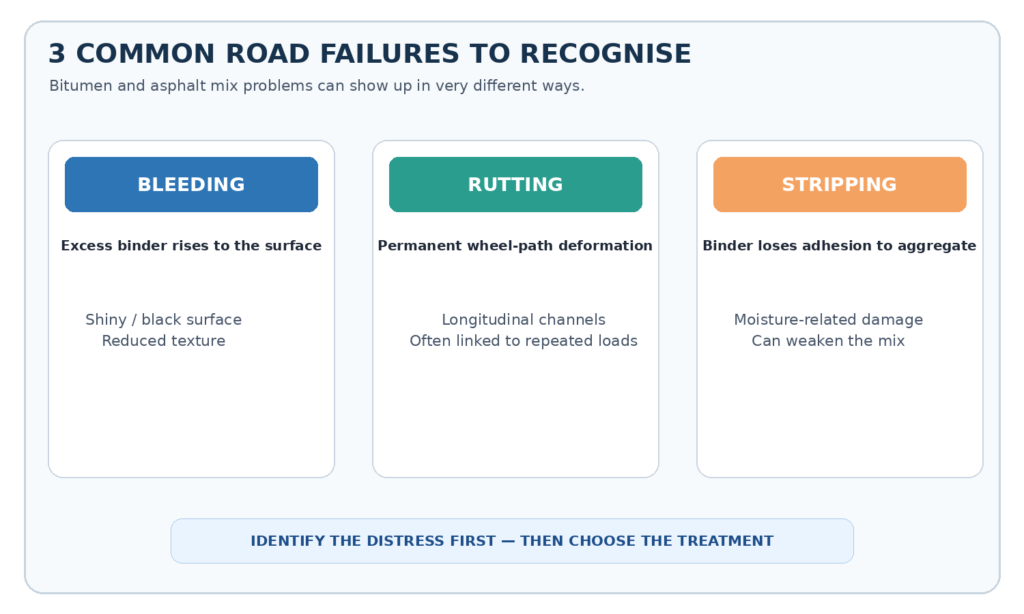
Alt text: Colour infographic showing three common asphalt pavement failures: bleeding, rutting and stripping, with a brief description of each visible distress.
What Are Bleeding, Rutting and Stripping?
| Failure | What you see | What is happening |
| Bleeding / flushing | Shiny, dark or tacky surface; aggregate texture may become obscured | Excess bituminous binder migrates upward to the pavement surface |
| Rutting | Longitudinal depressions or channels in wheel paths | Permanent deformation develops in the asphalt layer, base, subbase or subgrade |
| Stripping | Loss of bond between binder and aggregate; may appear as deterioration inside the mix | Moisture contributes to loss of adhesion and can weaken the asphalt mixture |
FHWA classifies rutting as a surface deformation and bleeding as a surface defect in its pavement distress identification system. Stripping is associated with loss of bond and moisture-related damage. citeturn0search0turn0search9
1. Bleeding: When Bitumen Comes to the Surface
Bleeding, sometimes called flushing, occurs when asphalt binder migrates upward and forms a film at the pavement surface.
FHWA describes bleeding as excess bituminous binder occurring on the pavement surface, often in wheel paths. At higher severity, the surface can become shiny or glass-like and lose the texture provided by the aggregate. citeturn0search0turn0search10
It is one of the easiest pavement failures to recognise — but the cause can be less obvious.
What causes bleeding?
One common cause is simply too much binder in the asphalt mixture. FHWA notes that excessive asphalt content and low air voids can contribute to bleeding. Excessive traffic can densify a mixture further, reducing available void space and encouraging binder to move toward the surface. citeturn0search25turn0search8
The Asphalt Institute also identifies a rich plant mix, an improperly constructed seal coat, excessive prime or tack coat application, and solvent carrying asphalt to the surface as possible causes. citeturn0search3
| Potential contributor | Why it can cause bleeding |
| Excess asphalt binder | Leaves insufficient space in the mixture for binder movement |
| Low air voids | Further densification can force binder toward the surface |
| Rich mix | Higher binder content increases the risk of surface migration |
| Excessive tack / prime / seal application | Adds asphalt beyond what the pavement system can accommodate |
| Hot weather | Softens binder and makes upward migration more likely |
| Stripping below the surface | Debonded asphalt can become mobile and contribute to surface bleeding |
This is why simply changing the binder grade may not solve a bleeding problem. The mix design, binder content and construction process need to be investigated as well.
Why bleeding is a safety concern
A heavily flushed surface can lose the microtexture and macrotexture needed for good tire-pavement friction. FHWA identifies bleeding and rutting among pavement conditions that can contribute to wet-weather safety problems. citeturn0search2
The problem can become more noticeable in hot weather, when the binder becomes softer and the surface film becomes more pronounced.
How bleeding is investigated
The first step is to determine whether the problem is genuinely excess surface binder and whether it extends into the mix.
If stripping is suspected beneath a bleeding surface, FHWA recommends coring and inspecting or testing samples. A surface seal will not repair a stripping problem. citeturn0search24
For low-to-moderate bleeding, certain surface treatments may be considered. High-severity bleeding may require removal of the affected surface before another treatment is placed. The appropriate treatment depends on severity and the actual mechanism.
2. Rutting: When Wheel Paths Become Channels
Rutting is the formation of longitudinal depressions in the wheel paths.
Drivers may notice the steering feel first. Engineers may notice the measured rut depth. During rain, the depression can also hold water, creating another safety concern.
But rutting is particularly important because **the rut you see at the surface does not necessarily mean the asphalt binder is the problem**.
FHWA explains that rutting can occur through permanent deformation in the asphalt layer or through accumulated deformation in the underlying base, subbase and subgrade. In one historical AASHO Road Test analysis cited by FHWA, only about 32% of final surface rutting was attributed to the asphalt layer, while the remainder was associated with underlying granular layers and subgrade. citeturn0search6turn0search26
That is a useful warning against diagnosing every rut as a binder failure.
When bitumen or the asphalt mix contributes to rutting
An asphalt mixture needs enough shear strength to resist repeated traffic loading, particularly under high pavement temperatures.
FHWA identifies unstable asphalt mixtures, low air voids, excessive wheel loads and high tire pressures among potential contributors to rutting. Excessive or overly soft asphalt can also reduce mixture stability. citeturn0search25turn0search5
| Potential contributor | Rutting mechanism |
| Binder too soft for conditions | Mix can deform more readily under repeated loads |
| Too much asphalt | Can reduce mixture stability when combined with unsuitable aggregate structure |
| Low air voids | Repeated loading can drive further densification and deformation |
| Heavy / repeated axle loads | Increase stress applied to the pavement |
| Weak base or subgrade | Permanent deformation develops below the asphalt |
| Moisture damage | Weakens supporting layers or contributes to stripping and deformation |
Rutting in hot climates
High pavement temperatures are particularly important because asphalt binder becomes less viscous as temperature rises.
For heavily trafficked roads in hot climates, binder selection should therefore consider the actual pavement temperature and traffic conditions rather than relying only on a generic penetration grade.
For performance-based binder selection, see Performance Grade Bitumen and Polymer Modified Bitumen
How rutting is diagnosed
Look at the shape and location of the rut.
A narrow wheel-path rut can point toward deformation in the asphalt layers. A broad depression can suggest deeper structural or foundation deformation. FHWA notes that the shape of the rut trough can help indicate where the permanent deformation originated. citeturn0search6
A proper investigation may therefore involve pavement cores, layer measurements, mix testing and examination of the base and subgrade rather than a binder test alone.
3. Stripping: When Water Breaks the Bond
Stripping is different from bleeding and rutting because the central problem is **loss of adhesion between asphalt binder and aggregate**, often associated with moisture.
FHWA explains that water entering an asphalt mixture can cause the asphalt binder to strip away from the aggregate, leaving the pavement vulnerable to cracking, rutting and other serious damage. citeturn0search7
The damage may begin below the surface, which means a road can look acceptable for a period before the consequences become obvious.
What causes stripping?
Water is a major part of the mechanism, but several factors determine whether moisture actually causes significant damage.
| Potential contributor | Why it matters |
| Moisture entering the pavement | Creates conditions for loss of binder–aggregate adhesion |
| Moisture-susceptible aggregate | Some aggregate–binder combinations are more vulnerable to moisture damage |
| Poor drainage | Keeps pavement layers wet for longer |
| High air voids / permeability | Makes it easier for water to enter the mixture |
| Inadequate anti-stripping treatment where required | Can leave a susceptible mixture more vulnerable |
| Poor construction / compaction | Can increase permeability and allow moisture movement |
The key point is that stripping is not simply “water touching bitumen.” It is a moisture-related loss of the bond between binder and aggregate within the pavement system.
Why stripping can lead to other failures
Once the binder–aggregate bond deteriorates, the mixture loses part of the cohesion that allows it to carry traffic.
FHWA notes that stripping can leave pavement vulnerable to cracking, rutting and other serious damage. It can also contribute to bleeding when debonded asphalt becomes mobile. citeturn0search7turn0search24
This is why a road can appear to have several different failures at once. The visible symptoms may be connected.
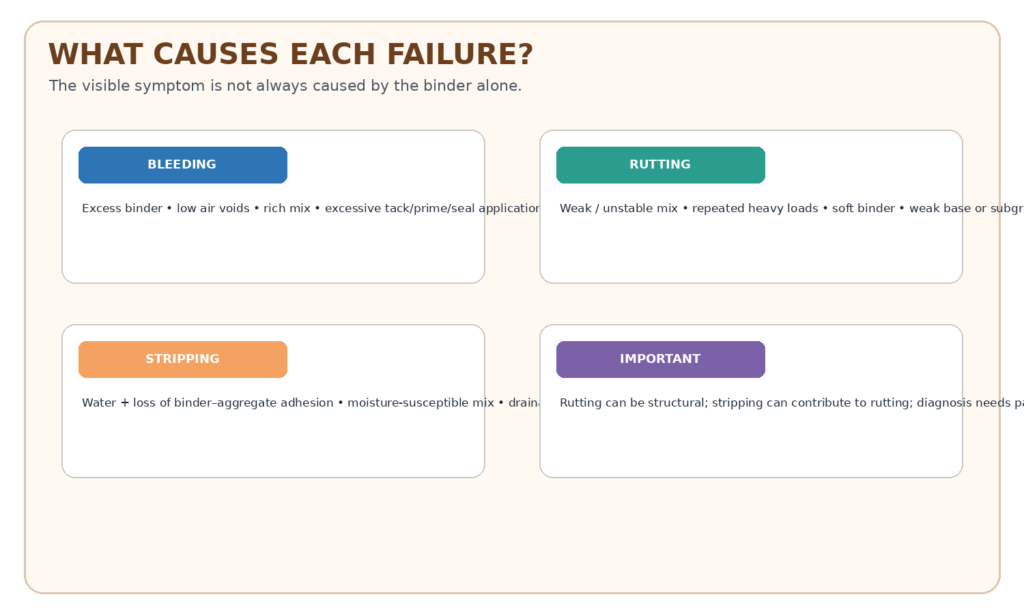
Alt text: Colour infographic showing common contributors to bleeding, rutting and stripping, including excess binder, low air voids, heavy traffic, weak foundations and moisture.
Bleeding vs Rutting vs Stripping: Quick Comparison
| Feature | Bleeding | Rutting | Stripping |
| Main visible sign | Shiny binder film / loss of texture | Wheel-path depressions | Internal loss of bond / aggregate deterioration |
| Primary mechanism | Binder migration to surface | Permanent deformation | Moisture-related loss of adhesion |
| Bitumen connection | Excess binder, low voids, application rate or softening | Binder and mix stiffness / stability can contribute | Binder–aggregate adhesion |
| Water involvement | Not always required | Can accelerate structural problems | Central factor in common stripping mechanism |
| Traffic effect | Can densify mix and worsen bleeding | Repeated heavy loads drive deformation | Traffic accelerates damage once bond is weakened |
| Typical diagnostic focus | Binder content, air voids, surface treatment | Layer deformation, mix stability, foundation | Moisture, adhesion, aggregate and drainage |
The Biggest Mistake: Blaming Every Failure on the Bitumen
Bitumen is important, but asphalt pavement is a system.
FHWA’s geotechnical guidance makes this especially clear for rutting: a surface rut may be caused partly or largely by permanent deformation in the base, subbase or subgrade. Moisture and drainage problems can also weaken those layers. citeturn0search6turn0search26
The same principle applies to stripping. A binder may meet its specification, but if the mixture is moisture-susceptible, poorly compacted or badly drained, the pavement can still experience damage.
Good pavement diagnosis therefore asks three questions:
What is the visible distress? Bleeding, rutting, stripping, cracking, raveling or another condition?
What is the mechanism? Binder migration, permanent deformation, moisture damage, fatigue or another process?
Where is the failure originating? Surface mix, asphalt layer, base, subbase, subgrade or drainage system?
How Binder Selection Can Reduce Risk
Binder selection should be matched to the pavement’s expected conditions.
For high-temperature and heavy-traffic applications, the binder needs enough resistance to deformation. For other climates and loading conditions, different performance characteristics become important.
The goal is not simply to choose the hardest bitumen available. A binder should be selected as part of the complete mix and pavement design.
For conventional paving applications, see Penetration Grade Bitumen.
For performance-based selection, see Performance Grade Bitumen.
For demanding applications where modified binder is appropriate, see Polymer Modified Bitumen.
How Moisture Management Protects the Pavement
Stripping and moisture-related rutting cannot be solved through binder selection alone.
The pavement needs effective drainage and a mixture with appropriate resistance to moisture damage.
FHWA identifies excessive moisture, inadequate drainage and weakening of pavement materials as important contributors to several forms of distress. citeturn0search6turn0search27
That means shoulders, drainage paths, edge details and pavement permeability deserve as much attention as the binder specification.
What About Tack Coat and Prime Coat Problems?
Not every surface binder problem comes from the main asphalt mix.
The Asphalt Institute lists an improperly constructed seal coat and excessive prime or tack coat as potential contributors to bleeding. citeturn0search3
This is why investigating the construction records can be useful. If bleeding is concentrated in particular areas, compare the distress pattern with paving operations, spray rates, mix production and traffic history.
How to Investigate a Road Before Choosing a Repair
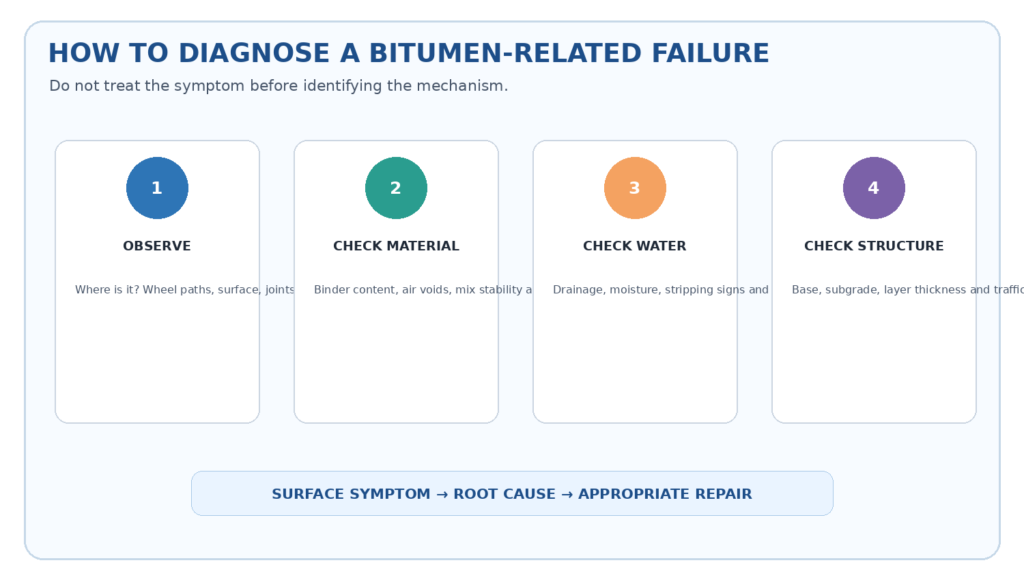
Alt text: Colour diagnostic infographic showing four steps for investigating pavement failure: observe the distress, check material properties, investigate water and examine pavement structure.
1. Map the distress. Record where the failure occurs and whether it follows wheel paths, joints, edges or isolated construction areas.
2. Examine the surface. Look for shine, texture loss, rut shape, loose aggregate, cracking and water evidence.
3. Test the mixture. Where appropriate, examine binder content, air voids, aggregate condition, moisture susceptibility and other relevant properties.
4. Investigate the structure. Check layer thickness, base/subbase condition, subgrade strength and drainage.
5. Review traffic and climate. Heavy loading and high temperatures can change the likely failure mechanism.
6. Review construction records. Check mix production, temperatures, compaction and application rates where available.
7. Choose treatment after diagnosis. Do not apply a surface treatment to a problem that originates below the surface.
Common Repair Approaches — and Their Limits
| Distress | Possible response | Important limitation |
| Low-to-moderate bleeding | Appropriate surface treatment may be considered | Treatment must account for existing excess binder |
| Severe bleeding | Milling / removal may be required before treatment | Surface treatment alone may not bond well |
| Asphalt-layer rutting | Milling, overlay or other rehabilitation may be considered | Confirm whether rutting is surface or structural |
| Deep structural rutting | Structural rehabilitation / reconstruction may be required | Treating only the surface will not fix weak foundation layers |
| Stripping | Remove and replace affected material or use appropriate rehabilitation | A surface seal does not repair stripping |
| Moisture-related damage | Correct drainage and moisture source alongside pavement repair | Ignoring water source can lead to repeat failure |
FHWA specifically warns that a surface seal will not repair stripping, and that treatment selection should depend on the actual distress mechanism and severity. citeturn0search24turn0search5
How to Prevent These Failures
Use the right binder. Match the binder to expected temperature and traffic conditions.
Design the mix properly. Control binder content, aggregate structure and air voids.
Control moisture. Provide drainage and reduce unnecessary water entry.
Compact correctly. Achieve the required density without over-densifying the mixture.
Control application rates. Prime, tack, seal and binder application need to match the design and specification.
Inspect early. Detect bleeding, rutting and moisture damage before they become severe.
Investigate root causes. A visible surface defect may be caused by deeper structural or drainage problems.
Frequently Asked Questions
Is bleeding caused by too much bitumen? Often, excess binder or low air voids contribute to bleeding, but other factors such as rich mixes, excessive surface-treatment application and hot weather can also play a role. citeturn0search25turn0search3
Is rutting always caused by bad bitumen? No. Rutting can originate in the asphalt mix, but it can also result from permanent deformation in the base, subbase or subgrade. citeturn0search6
What is stripping in asphalt pavement? Stripping is moisture-related loss of adhesion between asphalt binder and aggregate. It can weaken the mixture and contribute to cracking and rutting. citeturn0search7
Can stripping cause rutting? Yes. FHWA notes that moisture-induced stripping can leave pavement vulnerable to rutting and other serious damage. citeturn0search7
Can bleeding be fixed with a seal coat? Not automatically. The treatment depends on severity and cause. FHWA notes that low-to-moderate bleeding may sometimes receive surface treatments, while severe bleeding may require milling; a seal will not repair underlying stripping. citeturn0search24
How can I prevent rutting on a hot-climate road? Use a pavement and binder system designed for the expected pavement temperature and traffic, maintain adequate mixture stability and address weak underlying layers.
Does PMB prevent rutting? Polymer modification can improve selected binder performance characteristics and may be appropriate for demanding applications, but it does not compensate for poor pavement structure, poor mix design or inadequate construction.
What is the best way to diagnose pavement failure? Identify the visible distress, determine its mechanism, and investigate the layer or system where the problem originates before selecting a treatment.
The Bottom Line
Bleeding, rutting and stripping can all involve bitumen, but they are not interchangeable failures — and none should automatically be blamed on the binder alone.
**Bleeding** is excess binder appearing at the surface. **Rutting** is permanent deformation, which can originate in the asphalt layers or deeper pavement structure. **Stripping** is loss of binder–aggregate adhesion associated with moisture and can contribute to other forms of distress.
The practical lesson is simple: **diagnose first, specify second, repair third.**
For project teams reviewing pavement performance, start by selecting the right Penetration Grade Bitumen or Performance Grade Bitumen for the application. Where high traffic or temperature demands justify modification, review Polymer Modified Bitumen. If moisture management or surface treatments are part of the project, Bitumen Emulsion may also be relevant. Finally, use Bitumen Grades & Standards for Infrastructure Tenders and Bitumen Storage, Handling & Transport Standards to keep the material specification, handling process and pavement performance requirements aligned.