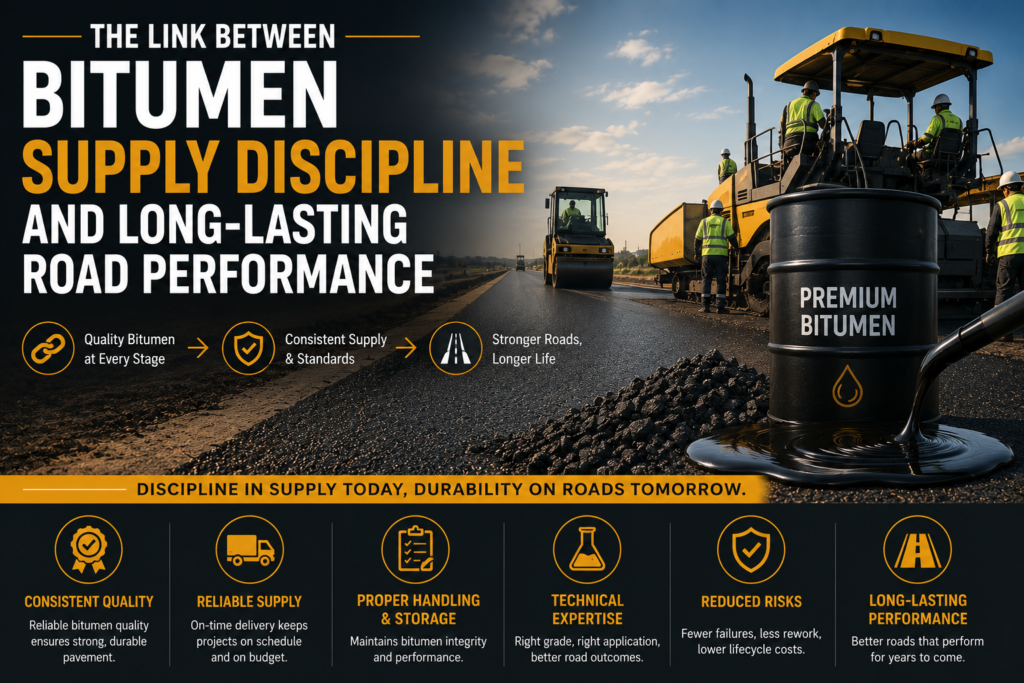
A poorly managed bitumen supply chain can reduce a road’s lifespan by 30% to 40% before its expected design life is over. That’s not a small problem.
For governments, contractors, and infrastructure developers, it means millions lost in premature repairs, traffic disruptions, delayed projects, and damaged public trust.
And here’s the part most buyers miss: road failures are not always caused by bad engineering. A huge percentage of them start much earlier — during sourcing, storage, transport, and handling of bitumen.
If you buy bitumen in bulk, your supplier discipline directly affects pavement durability. The consistency of temperature control, grade quality, delivery scheduling, storage stability, and batch uniformity can determine whether a highway lasts 15 years or starts cracking in five.
That’s why procurement teams across the UAE, Saudi Arabia, India, and African infrastructure markets are paying far more attention to supply reliability than ever before. Because long-lasting roads are not built with asphalt alone. They’re built with disciplined bitumen logistics.
Why Roads Fail Faster Than Expected
Most road deterioration begins long before visible cracking appears. By the time potholes show up, the underlying structural damage has already been developing for months — sometimes years. And in many cases, inconsistent bitumen supply is one of the root causes.
Here’s what commonly goes wrong when supply discipline is weak:
- Bitumen arrives overheated
- Storage temperatures fluctuate excessively
- Deliveries are delayed during paving windows
- Different batches have inconsistent penetration values
- Moisture contamination occurs during transport
- Inferior grades are substituted to reduce cost
Each issue may seem minor individually. Combined, they become catastrophic for road performance. According to multiple pavement engineering studies, binder inconsistency is one of the leading contributors to rutting, stripping, fatigue cracking, and thermal damage in asphalt pavements. That means your supplier is not just delivering material — they are influencing pavement lifespan.
The Hidden Cost of “Cheap” Bitumen Procurement
Many buyers still focus heavily on price per metric ton. That’s understandable — large-scale infrastructure projects operate under strict budget pressure. But there’s a dangerous misconception in the market: lower upfront procurement cost does not equal lower total project cost.
In reality, roads built with inconsistent or poorly handled bitumen often generate far higher lifecycle expenses through:
- Early maintenance
- Surface rehabilitation
- Traffic disruption costs
- Contractor penalties
- Reduced pavement performance
- Increased public complaints
A 5% savings on procurement can easily become a 25% increase in long-term maintenance expenditure. That’s why experienced infrastructure developers increasingly prioritize supplier reliability over lowest bidding price alone. The cheapest bitumen can become the most expensive road you ever build.
The Real Connection Between Bitumen Supply Discipline and Road Longevity
Most people think road durability depends only on mix design and construction quality. Those matter. But supply discipline quietly affects every single stage of asphalt performance.
When bitumen is improperly sourced, transported, heated, or stored, its physical properties begin to change. Oxidation accelerates. Viscosity shifts. Adhesion weakens. Elastic recovery declines. And once the binder loses performance stability, the pavement structure starts deteriorating much earlier.
This is why professional contractors increasingly demand strict supply-chain quality assurance from every bitumen supplier UAE infrastructure projects depend on. Because consistency creates durability — and durability creates long-term ROI.
1. Consistent Bitumen Grade Quality Prevents Premature Pavement Failure
Not all bitumen behaves the same under traffic load and climate conditions. That’s where grade consistency becomes critical. If one shipment differs slightly from another, the asphalt mix performance can become unpredictable.
This is especially dangerous in regions with:
- Extreme heat
- Heavy axle loads
- High traffic density
- Desert climate exposure
- Monsoon moisture cycles
For example, roads in the UAE and Saudi Arabia experience pavement surface temperatures exceeding 70°C during peak summer periods. Under these conditions, inconsistent binder quality dramatically increases rutting risk. Meanwhile, roads in India and African regions often face combined moisture and heat stress, making adhesion stability even more important.
What Disciplined Suppliers Do Differently
Reliable suppliers maintain:
- Tight refinery sourcing standards
- Consistent penetration grading
- Stable viscosity profiles
- Batch-level quality testing
- Controlled blending procedures
- Verified compliance documentation
This ensures every shipment performs predictably during asphalt production and road laying — and predictable performance is what creates long pavement life.
Why Procurement Teams Should Care
When you buy bitumen in bulk, you are not buying a commodity alone. You are buying performance consistency across thousands of tons. Even small grade variations can create massive performance differences once roads face real traffic pressure. That’s why disciplined sourcing matters more than many buyers realize.
Key insight: Long-lasting roads start with consistent binder behavior — not just competitive pricing.
2. Temperature-Controlled Logistics Protect Bitumen Performance
Bitumen is highly temperature-sensitive. And improper heating is one of the fastest ways to damage it. When bitumen overheats during storage or transport, oxidation accelerates rapidly. That causes:
- Hardening of the binder
- Reduced flexibility
- Lower fatigue resistance
- Increased cracking potential
In simple terms: the road ages faster before vehicles even drive on it.
Why Logistics Discipline Matters
A professional bitumen supplier UAE contractors trust must maintain strict thermal controls throughout the supply chain.
During Storage
- Stable tank temperatures
- Proper insulation systems
- Continuous monitoring
During Transportation
- Heated tanker management
- Transit-time optimization
- Temperature retention controls
During Discharge
- Controlled pumping systems
- Minimal heat fluctuation
- Safe handling procedures
Without these controls, bitumen quality can degrade significantly before reaching the asphalt plant.
The Problem With Inconsistent Heating
Some suppliers repeatedly reheat stored bitumen to compensate for poor inventory planning. That’s a serious issue. Repeated heating cycles alter binder chemistry and reduce long-term pavement resilience. Over time, roads become more vulnerable to:
- Thermal cracking
- Rutting
- Oxidative aging
- Surface brittleness
This is particularly dangerous for highways, airports, and industrial road infrastructure where stress loads are extreme.
Key insight: The road’s lifespan can be shortened before paving even begins if thermal discipline is ignored.
3. Supply Reliability Directly Affects Asphalt Paving Quality
Timing matters enormously in road construction. Asphalt paving operates within narrow production and weather windows. If bitumen deliveries arrive late, entire paving schedules collapse. That creates operational chaos:
- Asphalt plants stop production
- Crews sit idle
- Compaction timing changes
- Surface uniformity suffers
- Joint quality deteriorates
And once paving consistency breaks down, pavement performance declines too.
Delays Create Structural Weaknesses
Interrupted paving operations often lead to:
- Weak longitudinal joints
- Uneven compaction
- Cold mix segregation
- Surface irregularities
These become early failure points under traffic loading. Reliable suppliers understand this — that’s why disciplined logistics planning is essential for major infrastructure projects.
What Strong Suppliers Prioritize
Professional suppliers focus heavily on:
- Inventory forecasting
- Port coordination
- Vessel scheduling
- Customs efficiency
- Regional warehousing
- Emergency contingency planning
This allows uninterrupted material flow even during high-demand periods. For large-scale contractors, that reliability is often more valuable than small price reductions — because delayed roads cost far more than delayed invoices.
Key insight: Reliable supply chains create smoother paving operations — and smoother paving creates stronger roads.
4. Storage Stability Impacts Long-Term Pavement Performance
Many infrastructure buyers underestimate storage management. That’s a mistake. Improper storage conditions can quietly destroy bitumen quality over time. Common issues include:
- Water contamination
- Sedimentation
- Excessive oxidation
- Temperature cycling
- Tank residue mixing
All of these affect asphalt performance.
Why Bulk Buyers Must Pay Attention
If you buy bitumen in bulk for large infrastructure projects, storage duration becomes a major factor. Long holding periods require:
- Stable temperature maintenance
- Tank cleanliness
- Controlled circulation systems
- Moisture prevention protocols
Without these controls, the binder gradually loses performance reliability.
Modified Bitumen Requires Even Greater Discipline
Polymer-modified bitumen products are even more sensitive. Poor storage management can cause:
- Polymer separation
- Reduced elasticity
- Loss of cohesion
- Inconsistent mixing behavior
That directly impacts rut resistance, fatigue life, and waterproofing performance. Experienced suppliers understand that storage is not just warehousing — it’s quality preservation.
Key insight: Bitumen performance does not only depend on production quality. It depends on how well the product is protected after production too.
5. Documentation, Testing, and Traceability Reduce Project Risk
Infrastructure procurement is becoming more data-driven. And for good reason. Major projects now require:
- Material traceability
- Compliance documentation
- Batch certifications
- Performance verification
- QA/QC reporting
That’s because accountability matters. When pavement failures occur, project stakeholders increasingly investigate supply-chain records.
What Disciplined Suppliers Provide
Professional suppliers support buyers with:
- Certificate of Analysis (COA)
- Penetration test reports
- Softening point data
- Viscosity reports
- Flash point testing
- Batch traceability documentation
This creates confidence during government audits, consultant reviews, contractor inspections, and quality assurance evaluations.
Why This Matters Financially
Poor documentation creates enormous commercial risk. It can lead to:
- Project disputes
- Delayed approvals
- Rejected shipments
- Compliance penalties
- Warranty complications
Disciplined suppliers reduce that uncertainty dramatically — and that stability becomes especially important on high-value infrastructure projects.
Key insight: Strong documentation protects both pavement quality and commercial accountability.
6. Regional Climate Expertise Improves Road Durability
Bitumen performance is climate-dependent. What works in one region may fail badly in another. This is where supplier expertise becomes critical. A knowledgeable bitumen supplier UAE infrastructure developers rely on understands how regional conditions influence binder selection.
Different Climates Require Different Performance Strategies
Middle East Markets
Extreme heat resistance is essential. Binders must withstand high pavement temperatures, heavy truck loads, and thermal aging stress.
Indian Markets
Moisture resistance becomes equally important due to monsoon exposure, humidity variation, and water infiltration risks.
African Infrastructure Projects
Road systems often face long transport distances, variable construction environments, high solar exposure, and heavy freight traffic.
A supplier without regional experience may recommend unsuitable grades or logistics strategies — creating long-term pavement vulnerabilities.
Why Experienced Suppliers Add More Value
Strong suppliers do more than deliver material. They help buyers:
- Select suitable grades
- Plan storage systems
- Optimize logistics timing
- Reduce climatic performance risks
- Improve pavement lifecycle expectations
That consultative approach significantly improves infrastructure outcomes.
Key insight: Roads last longer when bitumen selection matches real environmental conditions.
Why Black Rock Bitumen Fits Long-Term Infrastructure Needs
Large infrastructure projects need more than product availability. They need consistency. That’s where Black Rock Bitumen positions itself differently.
As a premium bitumen supplier UAE contractors and infrastructure developers work with across the Middle East, Asia, and Africa, the company focuses heavily on supply discipline, logistics stability, and quality assurance. Instead of treating bitumen like a basic commodity, the approach centers around performance reliability. That includes:
- Consistent sourcing standards
- Controlled logistics systems
- Reliable export coordination
- Bulk supply capability
- Technical documentation support
- Timely shipment planning
For procurement managers handling large-scale projects, those operational details matter enormously — because stable supply chains reduce operational uncertainty, and reduced uncertainty improves project execution.
The Importance of Export Experience
International bitumen supply is complex. There are shipping variables, customs procedures, storage requirements, regional regulations, and timing constraints. An experienced exporter understands how to manage those moving parts without disrupting contractor operations. That becomes especially valuable when projects involve:
- Cross-border infrastructure programs
- Government tenders
- Remote construction zones
- High-volume procurement cycles
Black Rock Bitumen’s regional export experience helps support those operational demands more efficiently — and that operational discipline often becomes a competitive advantage for project owners themselves.
Real-World Scenario: Two Highway Projects, Two Different Outcomes
Imagine two highway contractors working on similar 200-kilometer road projects. Both use similar asphalt plants. Both have skilled engineering teams. Both operate within similar budgets. But their supply strategies differ.
Project A: Lowest-Cost Procurement Strategy
The contractor selects the cheapest available supplier. Initially, procurement savings look impressive. But problems begin quickly:
- Delivery schedules become inconsistent
- Temperature fluctuations affect asphalt production
- Batch quality varies slightly
- Plant downtime increases
- Paving interruptions occur
Within three years: rutting appears, cracking accelerates, surface irregularities develop, and maintenance costs rise sharply.
Project B: Disciplined Supply Strategy
The second contractor prioritizes consistent grade quality, reliable delivery schedules, proper thermal handling, documentation transparency, and stable inventory planning. The upfront cost is slightly higher. But the pavement performs consistently. After several years: surface integrity remains stronger, maintenance frequency stays lower, lifecycle costs improve significantly, and public disruption decreases.
This is the real economics of infrastructure procurement. Road performance is heavily influenced by supply-chain discipline long before traffic touches the pavement.
What Procurement Leaders Should Evaluate Before Choosing a Supplier
If you buy bitumen in bulk regularly, supplier evaluation should go far beyond price comparison. Here are the factors experienced procurement teams increasingly prioritize:
1. Quality Consistency
Ask for batch testing records, refinery sourcing transparency, and product specification stability.
2. Logistics Capability
Evaluate fleet management, export handling, delivery reliability, and regional warehousing.
3. Thermal Management Systems
Confirm heated transport controls, storage monitoring, and temperature management protocols.
4. Documentation Standards
Review COAs, compliance certifications, traceability systems, and QA/QC processes.
5. Regional Experience
Choose suppliers who understand local climate stress, regional regulations, and infrastructure operating conditions.
6. Scalability
Ensure the supplier can support long-term contracts, large-volume orders, and emergency supply fluctuations.
The stronger the supplier discipline, the stronger the pavement performance usually becomes.
Key Takeaways
- Road durability is strongly influenced by bitumen supply discipline, not just paving quality.
- Inconsistent heating, delayed delivery, and poor storage can significantly reduce pavement lifespan.
- Reliable logistics improve paving consistency and structural road integrity.
- Procurement decisions based only on lowest price often increase long-term maintenance costs.
- Choosing an experienced bitumen supplier UAE infrastructure markets trust can improve lifecycle performance dramatically.
- Climate-specific expertise plays a major role in selecting the right binder strategy.
- Strong documentation and traceability reduce commercial and operational risk.
Build Roads That Last Longer With the Right Supply Partner
The difference between a road that lasts five years and one that lasts fifteen is rarely accidental. It comes from disciplined decisions made throughout the supply chain.
When you choose a supplier with strong quality control, reliable logistics, thermal management expertise, and regional infrastructure experience, you reduce risk across the entire project lifecycle. That’s exactly why developers, contractors, and procurement teams across the Middle East, Asia, and Africa continue partnering with Black Rock Bitumen.
If your next infrastructure project requires reliable bulk supply, consistent product quality, and export-ready logistics support, now is the time to strengthen your sourcing strategy.
Contact Black Rock Bitumen today to discuss your project requirements, request technical specifications, or receive a customized bulk supply quotation.
Frequently Asked Questions
How do I evaluate whether a bitumen supplier has genuine logistics discipline?
Ask for specific evidence rather than assurances. Request vessel scheduling records, delivery performance history, storage temperature monitoring logs, and references from comparable infrastructure projects. Evaluate whether the supplier has regional warehousing capacity, customs handling expertise, and contingency protocols for supply disruptions. A supplier with genuine logistics discipline will answer these questions with data — not generalities.
How much can poor bitumen supply discipline add to a road project's long-term cost?
Research on pavement lifecycle costs consistently shows that premature road failure increases total project lifecycle costs by 30–50% over the original construction estimate. A 5% saving on bitumen procurement can easily translate into a 25% increase in long-term maintenance expenditure when supply discipline is poor. For a project worth USD 10 million, that represents USD 2.5 million in avoidable costs — far outweighing any price saving achieved at procurement stage.
What documentation should I demand from a bitumen supplier to protect my project?
At minimum, demand batch-specific Certificates of Analysis (COA) — not generic templates — along with penetration test reports, softening point data, viscosity reports, flash point testing results, and full batch traceability documentation linking each delivery to its refinery source and test date. For government or World Bank-funded projects, additional compliance certifications against the specified standard (IS 73, EN 12591, ASTM D946, etc.) are typically required. Strong documentation protects you during audits, quality reviews, and any commercial disputes that may arise.
Can poor storage conditions damage bitumen even if it met specification at the point of supply?
Yes — and this is one of the most underappreciated risks in bitumen procurement. Even specification-compliant bitumen can degrade significantly if stored improperly. Water contamination, sedimentation, temperature cycling, and excessive oxidation during storage all alter the binder’s physical properties. For polymer-modified bitumen (PMB), poor storage can cause polymer separation — destroying the enhanced performance properties that justified the premium cost in the first place.
Why does batch-to-batch consistency matter so much for road projects?
Asphalt mix design is calibrated to a specific bitumen grade and viscosity profile. When batches vary — even slightly — the mix behaves unpredictably during production and compaction. This leads to inconsistent density, poor aggregate bonding, and variable pavement stiffness across different sections of the same road. Over time, these inconsistencies translate into differential rutting, cracking, and surface deformation that are both expensive to repair and difficult to attribute to a specific cause.
How does overheating during transport affect bitumen quality?
When bitumen is exposed to excessive heat during transport or storage, oxidation accelerates rapidly. This causes the binder to harden, lose flexibility, and reduce fatigue resistance. The result is a material that behaves as though it has already aged — meaning the road it produces will crack and deteriorate significantly earlier than designed. Repeated reheating cycles compound this damage, making temperature discipline one of the most critical — and most overlooked — aspects of bitumen logistics.
What does "bitumen supply discipline" actually mean in practice?
Bitumen supply discipline refers to the systematic control of every stage in the bitumen supply chain — from refinery sourcing and temperature management during storage and transport, to batch consistency, delivery scheduling, and documentation accuracy. A disciplined supplier maintains tight quality standards at every handover point so that the bitumen arriving at the asphalt plant performs identically to the bitumen that was specified and tested at source.

Content Writer, Global Bitumen Supply & Market Insights, Black Rock Bitumen
Farheen Fatima is an infrastructure materials writer specializing in bitumen supply, asphalt technology, and global road construction. He shares practical insights on bitumen grades, supplier evaluation, and international standards to help contractors and project teams make informed procurement decisions.