A single delayed bitumen shipment can stall an entire highway corridor. Not by hours. By weeks.
According to global infrastructure studies, supply chain disruptions can increase large-scale construction project costs by as much as 20% and delay completion timelines by several months. In national road programs, where projects span hundreds of kilometers and involve multiple contractors, one missing material delivery can create a domino effect across labor, machinery, funding, and public infrastructure targets.
And yet, most procurement teams still operate with limited visibility into where materials are, when they will arrive, and whether suppliers can actually deliver at scale. That’s the real problem — not just sourcing bitumen, but controlling the entire supply chain behind it.
If you’re a procurement manager, infrastructure developer, government project head, or EPC contractor handling national road projects across the UAE, Saudi Arabia, India, or Africa, supply chain visibility is no longer optional. It’s operational insurance. And the companies that understand this are finishing projects faster, reducing cost overruns, and building roads that last longer.
The Hidden Problem Behind Delayed National Road Projects
Road infrastructure projects rarely fail because of engineering. They fail because logistics break down. A contractor may secure approvals, mobilize equipment, and deploy workforce on schedule — only to face delays because critical materials arrive late or inconsistently.
Bitumen is one of the most sensitive materials in the entire road construction ecosystem. Why? Because road paving schedules depend heavily on temperature control, delivery timing, storage coordination, and batching consistency. When visibility is poor, problems multiply fast.
Here’s What Usually Goes Wrong
- Suppliers overpromise production capacity
- Procurement teams receive delayed shipment updates
- Port congestion creates unexpected delivery gaps
- Transport documentation slows customs clearance
- Bitumen grades arrive inconsistently
- Inventory tracking becomes inaccurate
- Contractors halt paving operations waiting for material
The financial impact is massive. Heavy paving equipment sitting idle can cost thousands of dollars per day. Labor inefficiencies rise. Government deadlines slip. Public pressure increases. And in many emerging infrastructure markets, delays trigger contractual penalties.
This is why experienced buyers no longer evaluate suppliers based only on price. They evaluate visibility.
Visibility Changes Everything
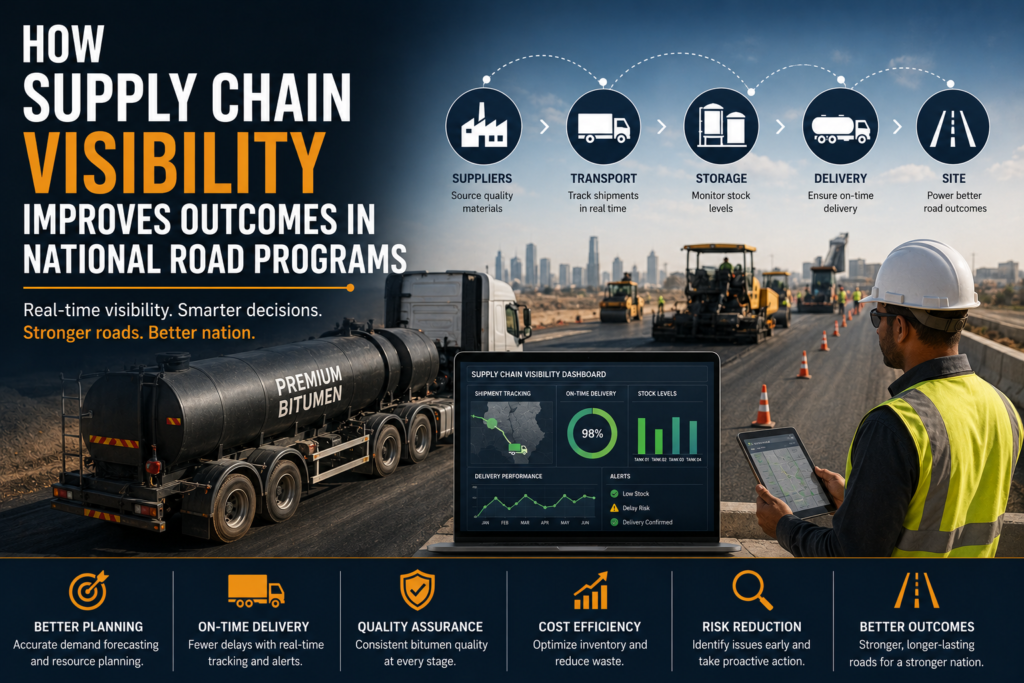
When procurement teams can track sourcing, refining, loading, shipment movement, storage availability, and delivery schedules in real time, decision-making improves dramatically. Instead of reacting to disruptions, teams can anticipate them. That difference alone can save millions in large-scale national road programs.
The takeaway: The most successful infrastructure projects are built on predictable supply chains, not just strong engineering plans.
Why Supply Chain Visibility Matters More Than Ever
The global construction supply chain has changed permanently over the last few years. Shipping volatility, fuel price fluctuations, geopolitical instability, port congestion, and refinery output shifts have made infrastructure procurement far more complex than it used to be. For road developers who buy bitumen in bulk, uncertainty is now one of the biggest risks in project execution — and uncertainty becomes expensive very quickly.
National Road Programs Depend on Continuous Material Flow
Unlike smaller municipal projects, national road programs operate at enormous scale. A single highway expansion may require:
- Tens of thousands of metric tons of bitumen
- Multiple delivery phases
- Cross-border logistics coordination
- Regional storage hubs
- Simultaneous contractor deployment
Without visibility, even small disruptions become amplified. If one shipment is delayed by seven days, paving schedules shift. When paving schedules shift, labor allocation changes. When labor allocation changes, equipment scheduling gets disrupted. Then project costs rise. This chain reaction happens constantly in large infrastructure programs.
The Cost of Poor Visibility Is Usually Hidden
Most companies only calculate direct material costs. But the real losses are indirect:
- Idle machinery costs
- Labor downtime
- Rework due to inconsistent material quality
- Contract extension penalties
- Emergency procurement premiums
- Fuel inefficiencies
- Reduced pavement lifespan
That’s why leading infrastructure buyers increasingly prioritize suppliers with transparent operational systems and predictable export capabilities. A reliable supply chain is now a competitive advantage.
The takeaway: Visibility doesn’t just improve logistics. It improves project profitability.
The 5 Ways Supply Chain Visibility Improves National Road Programs
1. Real-Time Shipment Tracking Reduces Downtime
One of the biggest frustrations for infrastructure procurement teams is uncertainty. Not knowing whether a shipment is delayed creates operational paralysis. When suppliers provide real-time shipment visibility, project managers can make smarter decisions earlier. That includes:
- Adjusting paving schedules
- Reallocating workforce
- Rescheduling plant operations
- Managing storage capacity
- Preventing equipment idling
This level of transparency is especially critical in cross-border infrastructure programs across Africa and Asia where shipping timelines can fluctuate significantly.
Why This Matters for Bitumen Procurement
Bitumen isn’t a material you can casually stockpile forever. Storage conditions matter. Temperature management matters. Delivery sequencing matters. A professional bitumen supplier UAE infrastructure buyers trust should provide detailed coordination across:
- Vessel scheduling
- Port handling
- Tank availability
- Delivery timelines
- Documentation updates
That’s how procurement teams maintain continuity across large paving operations. Projects become proactive instead of reactive — and that single shift improves execution speed dramatically.
The takeaway: Real-time logistics visibility reduces uncertainty, and uncertainty is one of the largest hidden costs in road construction.
2. Inventory Visibility Prevents Critical Material Shortages
National infrastructure projects consume massive material volumes. And bitumen demand doesn’t remain constant throughout the project lifecycle — consumption spikes during intensive paving periods. Without accurate inventory visibility, contractors often face two dangerous problems:
Problem #1: Overstocking — Excess inventory ties up working capital and increases storage risks.
Problem #2: Understocking — Insufficient inventory causes project stoppages.
Both scenarios hurt profitability. That’s why modern infrastructure procurement increasingly depends on synchronized inventory management between suppliers, storage terminals, and contractors.
Smart Procurement Requires Demand Forecasting
The best suppliers don’t simply deliver product. They help clients forecast supply requirements based on:
- Project phase timelines
- Seasonal demand fluctuations
- Climate conditions
- Regional transport constraints
- Production capacity
This is particularly important in high-growth regions where road infrastructure spending continues rising rapidly. According to international infrastructure projections, trillions of dollars are expected to flow into transport development across Asia, the Middle East, and Africa over the next decade. That means supply pressure will continue increasing — and companies that improve visibility today will outperform competitors tomorrow.
The takeaway: Accurate inventory visibility protects both operational continuity and cash flow.
3. Quality Traceability Improves Road Performance
Most procurement failures are blamed on delays. But inconsistent material quality can be even more damaging long term. Road failure rarely happens immediately — it appears months or years later through rutting, cracking, surface deformation, and premature deterioration. And in many cases, poor-quality or inconsistent bitumen plays a major role.
Visibility Creates Accountability
When supply chains are transparent, procurement teams gain traceability into:
- Refinery sourcing
- Grade consistency
- Batch testing
- Compliance documentation
- Quality assurance procedures
This matters because national highways face extreme operational stress: heavy freight traffic, high surface temperatures, seasonal weather fluctuations, and continuous axle loading. A small quality inconsistency at supply stage can translate into massive maintenance costs later.
Why Procurement Teams Are Becoming More Selective
Experienced infrastructure buyers increasingly work with suppliers that prioritize standardized quality systems and transparent testing documentation. That’s one reason companies like Black Rock Bitumen continue strengthening relationships across regional infrastructure sectors — because consistency builds trust, and trust becomes essential in long-duration government projects.
Better Visibility Also Supports Compliance
Many public infrastructure tenders now require stricter documentation and traceability. Without proper visibility, compliance risks increase significantly — delaying approvals, triggering audits, or creating payment bottlenecks.
The takeaway: Supply chain visibility doesn’t just protect delivery schedules. It protects road quality itself.
4. Predictive Planning Reduces Project Risk
Most infrastructure disruptions are not completely unpredictable. The problem is that many companies discover issues too late. Supply chain visibility changes that — instead of reacting after delays happen, procurement teams can identify risks before they become operational disasters.
Predictive Visibility Helps Teams Prepare Earlier
For example, if a supplier identifies refinery output constraints early, contractors can:
- Adjust delivery sequencing
- Increase temporary inventory
- Shift paving schedules
- Secure alternative transport arrangements
Without visibility, none of those decisions happen in time.
This Is Especially Important in International Infrastructure Markets
Large road projects across Africa and Asia often depend on imported materials. That means procurement teams face additional exposure to:
- Port delays
- Customs processing
- Freight disruptions
- Currency fluctuations
- Regional political instability
Visibility helps reduce the impact of these external variables.
The Best Suppliers Function Like Strategic Partners
A transactional supplier focuses only on shipment completion. A strategic supplier helps clients reduce operational risk. That distinction matters enormously in national infrastructure programs worth hundreds of millions of dollars. Black Rock Bitumen has positioned itself within this strategic category by focusing heavily on reliability, export coordination, and consistent supply management for regional infrastructure projects — and buyers notice the difference quickly.
The takeaway: Predictive visibility helps infrastructure teams solve problems before they become expensive delays.
5. Better Coordination Improves Overall Project Efficiency
Infrastructure projects involve multiple moving parts simultaneously. You’re coordinating contractors, government agencies, transport operators, site engineers, storage terminals, procurement teams, and suppliers. Without centralized visibility, communication gaps become inevitable — and communication gaps create inefficiency.
Visibility Aligns Stakeholders
When everyone operates from the same supply information, execution becomes smoother:
- Project managers know delivery timelines
- Site teams know material availability
- Procurement teams know reorder schedules
- Finance teams understand inventory flow
That operational alignment improves productivity significantly.
Why This Matters Financially
Small inefficiencies compound fast across large-scale infrastructure programs. A two-day delay on a small road repair project may be manageable. But a two-day delay on a national highway corridor involving multiple contractors can create enormous downstream disruption. This is why visibility is becoming a core procurement requirement rather than a “nice-to-have” feature.
Digital Supply Coordination Is Becoming Standard
Across the global construction sector, digital logistics tracking and procurement visibility tools are increasingly becoming industry standard. Infrastructure developers now expect suppliers to provide:
- Shipment transparency
- Documentation tracking
- Delivery coordination
- Responsive communication
- Inventory forecasting support
Suppliers unable to provide this level of operational clarity will increasingly struggle to compete.
The takeaway: Better coordination improves execution speed, reduces waste, and strengthens infrastructure project performance.
Why Supplier Selection Directly Impacts Visibility
Not all suppliers operate at the same level. Some simply broker material. Others manage integrated supply operations. That difference matters far more than most buyers realize.
A Strong Supplier Creates Operational Stability
The right supplier helps infrastructure buyers:
- Maintain consistent material flow
- Improve forecasting accuracy
- Reduce delivery uncertainty
- Strengthen quality control
- Simplify export coordination
- Improve project planning
This is especially important when companies buy bitumen in bulk for multi-phase road programs. Large infrastructure projects require scalable supply reliability — not short-term transactional purchasing.
What Procurement Teams Should Evaluate
When selecting a supplier, experienced buyers look beyond pricing alone. They evaluate:
- Export capability
- Regional logistics strength
- Supply consistency
- Storage coordination
- Documentation efficiency
- Communication responsiveness
- Product quality assurance
- Long-term operational reliability
This is why infrastructure developers across the Middle East, India, and Africa increasingly prefer suppliers with proven export infrastructure and transparent operational systems.
Where Black Rock Bitumen Fits Into This
Black Rock Bitumen has built its reputation by focusing on operational reliability, consistent export performance, and supply coordination across infrastructure sectors. Instead of functioning purely as a commodity trader, the company supports clients with structured supply management that aligns with the realities of large-scale road development projects. That distinction matters in national infrastructure programs where delays become extremely expensive.
The takeaway: The right supplier improves more than procurement. They improve the entire project ecosystem.
A Real-World Scenario: How Visibility Prevents a Highway Project Delay
Imagine a government-backed highway expansion project in East Africa. The project involves 400+ kilometers of roadway, multiple contractors, strict milestone deadlines, imported bitumen shipments, and seasonal weather limitations. The paving schedule is tightly planned.
Without Visibility
One shipment gets delayed unexpectedly at port. Site teams continue preparing for paving operations assuming material will arrive on time. Equipment is mobilized. Labor is allocated. Plants are scheduled. Then the delay becomes visible too late. Operations stop. Costs increase daily. Deadlines slip.
With Full Supply Chain Visibility
The supplier identifies shipment delays early. Procurement teams receive updates immediately. Schedules are adjusted proactively. Temporary stock reserves are redistributed. Alternative logistics arrangements are explored. The project continues with minimal disruption.
That’s the operational value of visibility. Not theory. Execution. And in large infrastructure programs, execution is everything.
The takeaway: Visibility doesn’t eliminate challenges. It minimizes their impact.
The Future of National Road Programs Depends on Supply Intelligence
Road infrastructure investment is accelerating globally. Governments across the Middle East, Asia, and Africa continue prioritizing economic corridors, freight connectivity, urban expansion, trade infrastructure, and industrial development. But as project scale increases, procurement complexity increases too. That means infrastructure success will increasingly depend on supply intelligence — not just material availability.
Procurement Is Becoming More Strategic
The old procurement model focused mainly on lowest-cost sourcing. That model is disappearing. Modern infrastructure procurement now prioritizes:
- Reliability
- Visibility
- Predictability
- Quality consistency
- Logistics coordination
- Long-term supplier partnerships
This shift is reshaping how national road programs operate — and suppliers that adapt early will become essential infrastructure partners.
Why This Matters Right Now
Demand pressure across global infrastructure supply chains continues rising. At the same time, buyers face increasing expectations around budget efficiency, delivery speed, road durability, compliance standards, and public accountability. Visibility helps solve all five. That’s why the most advanced infrastructure projects now treat supply chain transparency as a strategic advantage rather than an operational detail.
The takeaway: The future of road construction belongs to organizations that combine engineering excellence with supply chain intelligence.
Key Takeaways
- Supply chain visibility reduces costly delays in national road programs.
- Real-time logistics tracking improves project coordination and execution.
- Inventory transparency helps prevent material shortages and overstocking.
- Quality traceability improves pavement durability and compliance.
- Strategic suppliers create operational stability beyond basic material delivery.
- Companies that buy bitumen in bulk increasingly prioritize reliability over lowest-cost sourcing.
- A trusted bitumen supplier UAE infrastructure developers rely on should provide transparency, consistency, and scalable export support.
Build Smarter Infrastructure With Better Supply Visibility
National road programs cannot afford unpredictable supply chains. Not when timelines are tight. Not when budgets are under pressure. And not when infrastructure quality directly impacts economic growth.
That’s why leading procurement teams across the Middle East, India, and Africa increasingly work with suppliers that provide more than material availability. They look for visibility. Consistency. Coordination. And long-term operational reliability.
Black Rock Bitumen supports infrastructure developers, contractors, and government road programs with dependable supply solutions designed for large-scale project execution. If your organization needs a trusted partner to buy bitumen in bulk with greater transparency and supply confidence, now is the time to strengthen your procurement strategy.
Contact Black Rock Bitumen today to discuss your project requirements, request a quote, and secure reliable bitumen supply for your next infrastructure development project.
Frequently Asked Questions
At what scale does supply chain visibility become essential rather than optional?
For projects consuming more than a few hundred metric tons of bitumen across multiple delivery phases, supply chain visibility becomes essential. This includes any national highway program, major urban road network expansion, or multi-contractor infrastructure project. At these scales, a single delayed shipment can cascade into a multi-week disruption affecting dozens of contractors and millions of dollars of planned work. For smaller projects with simple, single-source supply arrangements, the need for real-time tracking is lower — but the discipline of documentation and quality traceability remains important regardless of project size.
How does supply chain visibility improve road quality — not just delivery reliability?
Visibility enables traceability — the ability to link every section of completed road back to specific bitumen batches, their test results, storage conditions, and handling records. If quality issues emerge months after construction, traceability data allows engineers to identify which batches were involved and investigate whether supply chain factors contributed. More importantly, the discipline that produces good traceability — consistent batch testing, temperature monitoring, and documentation — is the same discipline that produces consistent material quality in the first place. Visibility and quality are therefore mutually reinforcing, not separate concerns.
How can predictive supply chain planning prevent project delays?
Predictive planning uses advance information — about refinery output schedules, vessel availability, port congestion forecasts, and seasonal demand patterns — to identify potential supply constraints before they create operational problems. When a supplier communicates early that a shipment may be delayed by ten days due to port congestion, the contractor has time to adjust paving schedules, redistribute temporary stock reserves, or arrange alternative transport. Without that early warning, the same ten-day delay becomes a full project stoppage. The value of predictive planning is not eliminating disruptions — it is reducing their impact to manageable levels.
What is the difference between a transactional bitumen supplier and a strategic supply partner?
A transactional supplier focuses on completing individual shipments — their role ends when the material is delivered. A strategic supply partner actively supports the client’s project execution by providing real-time shipment visibility, demand forecasting assistance, proactive communication about potential disruptions, flexible scheduling to match project phases, and transparent documentation throughout. For national road programs spanning multiple years and phases, strategic partners reduce total project risk significantly compared to transactional relationships that prioritize only the lowest price per ton.
Why is bitumen particularly difficult to manage in terms of supply chain visibility?
Unlike dry construction materials, bitumen is temperature-sensitive, requiring controlled heating throughout the supply chain. It cannot be indefinitely stockpiled without risk of oxidation and quality degradation. Delivery timing must align precisely with asphalt plant production schedules and weather windows for paving. These constraints mean that a delayed or incorrectly handled shipment cannot simply be held and used later without consequences — making real-time visibility into delivery status far more operationally critical than for most other construction materials.
How does poor supply chain visibility translate into financial losses on road projects?
The financial losses from poor visibility are mostly indirect and therefore frequently underestimated. When a bitumen delivery is delayed without warning, paving equipment sits idle at costs of thousands of dollars per day, labor is paid without productive output, plant operations are disrupted, and cold weather or weather windows may close — requiring rescheduling. If paving is interrupted mid-section, joint quality suffers, creating structural weak points that increase future maintenance costs. Additionally, delayed project milestones can trigger liquidated damages under government contracts. Collectively, these costs can increase total project expenditure by up to 20% according to global infrastructure research.
What does supply chain visibility mean in the context of bitumen procurement?
Supply chain visibility in bitumen procurement refers to the ability to track and monitor every stage of the material’s journey — from refinery sourcing and production, through loading, shipping, port handling, storage, and final delivery to site. It gives procurement managers real-time or near-real-time information about where materials are, when they will arrive, and whether any disruptions are developing. This allows proactive decision-making rather than reactive crisis management — which in large national road programs can mean the difference between a project staying on schedule or incurring significant cost overruns.

Content Writer, Global Bitumen Supply & Market Insights, Black Rock Bitumen
Farheen Fatima is an infrastructure materials writer specializing in bitumen supply, asphalt technology, and global road construction. He shares practical insights on bitumen grades, supplier evaluation, and international standards to help contractors and project teams make informed procurement decisions.