

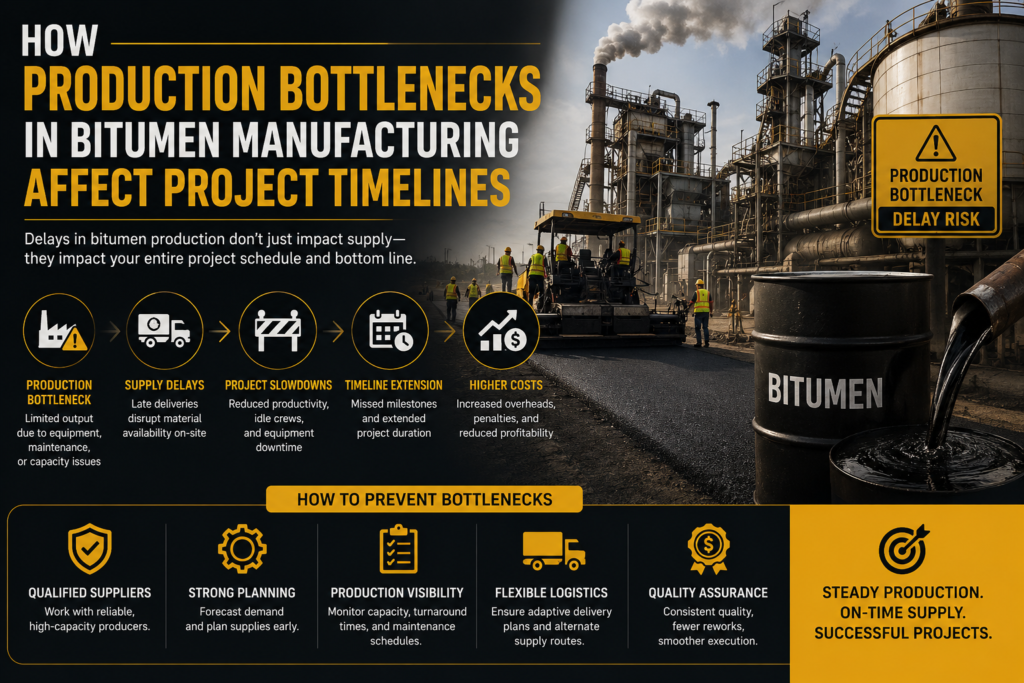
How Production Bottlenecks in Bitumen Manufacturing Affect Project Timelines
A single delayed bitumen shipment can stall a multi-million-dollar infrastructure project for weeks. That sounds dramatic. But it happens more often than most procurement teams want to admit.
According to industry estimates, material supply disruptions account for nearly 30% of construction project delays globally, especially in road infrastructure and highway development. In large-scale paving projects, bitumen is one of the few materials that directly controls sequencing. If supply slows down, everything behind it slows down too.
Your labor crews wait. Your asphalt plants sit idle. Your equipment rental costs keep climbing. And your completion deadline starts slipping. That’s the real cost of production bottlenecks in bitumen manufacturing.
Most buyers focus heavily on price per metric ton when they buy bitumen in bulk. But experienced contractors know something more important: reliable production capacity matters just as much as pricing. Because when your supplier cannot manufacture, process, store, or dispatch bitumen on time, your project timeline absorbs the damage. And in government infrastructure projects across the UAE, Saudi Arabia, India, and Africa, delays often trigger penalties, political pressure, and escalating operational costs.
This article breaks down exactly how production bottlenecks happen, why they create major downstream delays, and how smart procurement teams reduce the risk before signing a supply contract.
Why Bitumen Manufacturing Delays Are More Dangerous Than Most Buyers Realize
Bitumen is not a simple commodity product. It requires controlled refining, blending, heating, storage, testing, and transportation coordination before it reaches your asphalt plant or construction site. That means production problems can happen at multiple stages simultaneously — and when they do, your schedule starts collapsing faster than expected.
Unlike cement or aggregates, bitumen is highly temperature-sensitive and logistics-dependent. It cannot simply sit exposed for long periods without proper storage and handling systems. So if a refinery experiences production slowdowns, terminal congestion, tank shortages, or export delays, the ripple effect spreads quickly across the entire infrastructure chain — especially in high-volume projects.
For example:
- A delayed tanker loading schedule in the UAE can affect road projects in East Africa within days
- Refinery maintenance shutdowns can create sudden regional supply shortages
- Poor storage infrastructure can reduce dispatch efficiency during peak demand
- Port congestion can delay imported grades required for highway specifications
And the larger your project becomes, the greater the impact. A 5-day delay on a 500-ton order is inconvenient. A 5-day delay on a 25,000-ton highway project can become financially catastrophic. That’s why experienced procurement managers increasingly evaluate operational reliability before finalizing long-term bitumen contracts.
Mini takeaway: The cheapest supplier is rarely the safest supplier when project deadlines are involved.
What Causes Production Bottlenecks in Bitumen Manufacturing?
Most project delays linked to bitumen supply come from five major bottleneck areas. Let’s break them down.
1. Refinery Capacity Constraints
Bitumen production depends heavily on refinery output. When crude processing volumes fluctuate, bitumen availability often changes with them. This becomes especially problematic during:
- Seasonal demand spikes
- Planned refinery maintenance
- Crude supply disruptions
- Export restrictions
- Geopolitical instability
Many buyers assume suppliers always maintain sufficient reserves. In reality, some suppliers rely heavily on spot procurement instead of secured production allocation — and that creates unpredictable supply cycles. For instance, during periods of high infrastructure activity in the Gulf region, demand for paving-grade bitumen can rise sharply within weeks. Suppliers without stable refinery partnerships often struggle to fulfill commitments consistently.
That’s where established exporters gain a major advantage. Companies like Black Rock Bitumen maintain structured sourcing and supply-chain coordination to minimize exposure to refinery volatility across regional markets. Because when refinery bottlenecks happen, your project usually hears about it too late.
Mini takeaway: Stable refinery access is one of the strongest predictors of on-time project execution.
2. Insufficient Storage Infrastructure
Storage capacity quietly determines whether suppliers can handle large infrastructure contracts smoothly. Yet many procurement teams overlook it entirely.
Here’s the problem. Bitumen must remain heated and properly stored before dispatch. Without sufficient storage terminals and heating systems, suppliers cannot maintain continuous outbound flow during high-demand periods. That creates dispatch bottlenecks — especially when multiple projects compete for supply simultaneously.
Common storage-related issues include:
- Limited heated tank capacity
- Poor temperature management
- Slow loading systems
- Inadequate inventory buffers
- Terminal congestion
These problems increase turnaround times dramatically. And once loading schedules start slipping, transportation delays compound the issue further. This is particularly relevant in export-heavy regions like the UAE, where efficient terminal infrastructure directly impacts delivery reliability across Asia and Africa.
A professional bitumen supplier UAE contractors trust typically invests heavily in:
- Heated storage systems
- Bulk inventory planning
- High-volume dispatch capability
- Multi-port coordination
- Backup storage arrangements
Because infrastructure-scale buyers care about continuity more than promises.
Mini takeaway: Suppliers with weak storage infrastructure often become bottlenecks during peak construction seasons.
Transportation Delays Amplify Manufacturing Bottlenecks
Production is only half the equation. Transportation failures often magnify manufacturing delays into full project disruptions — and this happens constantly in cross-border infrastructure projects.
3. Port Congestion and Export Delays
International bitumen supply depends heavily on marine logistics. If ports become congested, your delivery schedule can collapse quickly. According to global shipping reports, port congestion increased vessel turnaround times significantly across major trade corridors over the past few years. While conditions have improved in some regions, infrastructure exporters still face periodic disruptions during high-volume trade cycles.
That affects:
- Bulk bitumen exports
- Drum-packed shipments
- Bitutainer movements
- Vessel scheduling
- Customs clearance timing
For buyers operating under strict government completion schedules, even minor export delays can trigger major cost escalation. Imagine this scenario: your paving crews are scheduled, your asphalt plant is prepared, your equipment rentals are active — but your vessel loading gets delayed by six days due to terminal congestion. Every downstream activity starts bleeding money immediately.
This is why experienced infrastructure developers increasingly prioritize suppliers with stronger logistics coordination networks. Black Rock Bitumen, for example, serves clients across the Middle East, Asia, and Africa through coordinated export planning and structured shipment management designed for large-volume infrastructure delivery timelines. Because in bitumen supply, logistics reliability is operational reliability.
Mini takeaway: Manufacturing efficiency means little if export logistics cannot support delivery timelines.
4. Poor Demand Forecasting
This issue destroys project timelines more often than most suppliers admit. Some suppliers simply fail to forecast demand accurately. When market demand spikes unexpectedly, production systems become overloaded. The result?
- Delayed allocations
- Shipment rescheduling
- Inventory shortages
- Priority conflicts between buyers
- Increased lead times
This commonly occurs during:
- Government infrastructure spending surges
- Monsoon recovery projects
- Highway expansion seasons
- Airport runway rehabilitation programs
The suppliers who survive these cycles successfully usually rely on proactive forecasting models rather than reactive procurement. That includes:
- Seasonal demand analysis
- Inventory buffer planning
- Refinery allocation forecasting
- Vessel scheduling optimization
- Regional infrastructure tracking
Without forecasting, supply chains become chaotic fast. And when supply chains become chaotic, project managers lose schedule control.
Mini takeaway: Strong forecasting systems reduce the risk of surprise delivery failures during peak infrastructure demand cycles.
How Bitumen Delays Directly Impact Construction Timelines
Most people underestimate how interconnected infrastructure scheduling really is. Bitumen delays do not just delay paving — they disrupt the entire project ecosystem.
Labor Costs Start Increasing Immediately
Idle crews are expensive. If your paving operations pause because material hasn’t arrived, labor expenses continue accumulating while productivity drops to zero. Large highway projects may involve:
- Asphalt crews
- Roller operators
- Traffic management teams
- Quality control engineers
- Plant operators
- Subcontractors
Every delayed day increases overhead costs. And unlike material pricing, labor inefficiency rarely gets recovered later. For major contractors, this becomes a margin killer.
Equipment Downtime Becomes Financially Painful
Heavy infrastructure equipment is not cheap. Neither are rental extensions. Delayed bitumen supply often leaves:
- Pavers inactive
- Milling machines unused
- Rollers parked
- Asphalt plants underutilized
Equipment downtime can cost thousands of dollars daily depending on project scale. And if delays extend long enough, rescheduling equipment availability becomes another operational nightmare — especially in regions where machinery demand is already high.
Mini takeaway: Bitumen supply interruptions create compounding operational losses beyond material costs alone.
Government Penalties and Contract Risks Increase
Infrastructure projects usually operate under strict milestone structures. Miss deadlines, and penalties often follow. These may include:
- Liquidated damages
- Payment withholding
- Contractual penalties
- Reduced future tender eligibility
- Reputation damage
For government contractors, timeline reliability is often tied directly to long-term business growth. That’s why procurement leaders increasingly evaluate supplier resilience instead of focusing solely on lowest-cost procurement models. A supplier that saves 2% on pricing but causes a 30-day delay can destroy project profitability entirely.
Mini takeaway: Supply reliability protects more than schedules — it protects contracts, reputation, and future business opportunities.
The Solution: How Smart Buyers Prevent Production Bottleneck Risks
Experienced buyers do not eliminate risk entirely. They reduce exposure strategically. Here are the most effective ways procurement teams protect project timelines.
1. Evaluate Production Capacity Before Signing Contracts
Most suppliers claim they can handle large-volume orders. Ask for proof. Specifically:
- Monthly production capability
- Refinery partnerships
- Storage capacity
- Dispatch infrastructure
- Historical export volume
- Backup sourcing systems
If suppliers hesitate to provide operational visibility, that’s usually a warning sign. Large infrastructure projects require scalable supply systems — not optimistic promises.
2. Prioritize Suppliers With Strong Regional Logistics Networks
Supply chains matter more than brochures. Ask questions like:
- Which export ports do they operate through?
- What are their average dispatch lead times?
- Do they maintain inventory buffers?
- Can they manage emergency supply requirements?
- How do they handle vessel scheduling disruptions?
Reliable logistics coordination separates industrial suppliers from trading intermediaries — and that distinction matters enormously during infrastructure peaks. A trusted bitumen supplier UAE contractors rely on should demonstrate both manufacturing coordination and transportation resilience.
Mini takeaway: Logistics capability is often the hidden factor behind consistent project execution.
3. Avoid Overdependence on Spot Market Procurement
Spot-market buying creates volatility. Yes, it may occasionally reduce short-term pricing. But it also increases exposure to:
- Sudden shortages
- Price spikes
- Delayed allocations
- Supply unpredictability
Long-term procurement planning usually delivers better operational outcomes — especially for multi-phase infrastructure projects. That’s why many large contractors establish framework agreements with suppliers capable of maintaining continuity over extended timelines. Black Rock Bitumen works with infrastructure buyers who prioritize predictable supply scheduling rather than purely transactional purchasing cycles. Because predictability matters in construction.
4. Build Buffer Inventory Into Large Projects
This strategy sounds simple. But it prevents major disasters. Many project delays happen because buyers operate with razor-thin inventory buffers. The moment supply slows, operations stop. Strategic inventory planning provides breathing room during temporary disruptions — even a modest reserve can protect critical paving schedules while suppliers resolve short-term bottlenecks.
This becomes especially important in regions vulnerable to:
- Port delays
- Weather disruptions
- Cross-border logistics slowdowns
- Seasonal demand spikes
Mini takeaway: Inventory buffers create schedule stability when supply chains become unpredictable.
Why Reliable Suppliers Become Competitive Advantages
Most people think of bitumen suppliers as vendors. High-performing contractors think of them as operational partners. Because the right supplier improves:
- Timeline consistency
- Project predictability
- Budget stability
- Operational efficiency
- Tender competitiveness
That’s especially true for government infrastructure projects where execution reliability influences future contract awards. A dependable bitumen supplier UAE can reduce procurement stress dramatically by offering:
- Consistent quality control
- Structured delivery scheduling
- Export coordination
- Technical documentation support
- Multi-market supply capability
This is where established suppliers gain long-term trust. Black Rock Bitumen has positioned itself as a premium supply partner for infrastructure developers across the UAE, Saudi Arabia, India, and African markets by focusing on operational reliability, export coordination, and scalable bulk supply capabilities. And for large projects, that operational consistency becomes incredibly valuable.
Mini takeaway: Reliable suppliers reduce operational uncertainty across the entire project lifecycle.
A Real-World Scenario: How One Delay Can Snowball Into a Major Infrastructure Problem
Imagine a highway expansion project in East Africa. The contractor schedules paving operations for a critical 45-day window before seasonal rains intensify. Everything is aligned:
- Asphalt plant readiness
- Labor deployment
- Equipment allocation
- Traffic management approvals
- Government milestone deadlines
Then the bitumen supplier encounters production delays. Refinery allocation slows. Terminal loading gets postponed. The export vessel misses its original schedule. Delivery arrives 12 days late.
Now the consequences begin multiplying:
- Crews remain idle
- Equipment rental costs rise
- Asphalt production schedules shift
- Rain exposure risk increases
- Government deadlines tighten
- Night-shift operations become necessary
- Budget overruns accelerate
What initially looked like a “small supply delay” evolves into a major operational disruption. And this happens across infrastructure markets more often than many buyers realize. The contractors who manage these risks successfully usually have one thing in common: they work with suppliers built for industrial-scale consistency — not just low-cost transactions.
Mini takeaway: Small supply-chain failures often create disproportionately large project consequences.
The Future of Bitumen Supply Chains Is Reliability, Not Just Pricing
Infrastructure spending continues growing across the Middle East, Asia, and Africa. That means demand pressure on bitumen manufacturing and logistics networks will likely intensify further over the next decade. At the same time, buyers face increasing pressure to complete projects faster, reduce cost overruns, improve quality standards, minimize downtime, and deliver within tighter public-sector timelines.
This changes procurement priorities. Reliability becomes strategic — not optional. The suppliers who thrive in this environment will likely be those investing in:
- Larger storage infrastructure
- Better forecasting systems
- Integrated logistics coordination
- Strong refinery partnerships
- Faster dispatch operations
- Regional export scalability
And buyers who adapt early will gain operational advantages over competitors still chasing the cheapest short-term pricing. Because in infrastructure development, delays usually cost far more than procurement savings.
Key Takeaways
- Production bottlenecks in bitumen manufacturing can delay entire infrastructure projects, not just material deliveries.
- Refinery constraints, storage limitations, logistics disruptions, and poor forecasting are the most common causes.
- Delayed bitumen supply increases labor costs, equipment downtime, and contractual risk exposure.
- Strong logistics coordination and scalable storage infrastructure significantly improve delivery reliability.
- Buyers who prioritize operational consistency over lowest-cost procurement often achieve better long-term project outcomes.
- Working with experienced suppliers like Black Rock Bitumen helps reduce timeline uncertainty in large-scale infrastructure projects.
Need a Reliable Bulk Bitumen Supply Partner?
If your infrastructure project depends on consistent delivery schedules, reliable export coordination, and scalable production support, choosing the right supplier becomes critical.
Black Rock Bitumen supplies premium-grade bitumen products to contractors, infrastructure developers, and government projects across the Middle East, Asia, and Africa. Whether you need to buy bitumen in bulk for highways, airport runways, industrial paving, or large-scale road construction, the team focuses on one thing that matters most: keeping your projects moving on schedule.
Contact Black Rock Bitumen today to discuss your project requirements, request technical specifications, or secure a reliable long-term supply partnership.
Frequently Asked Questions
How does working with a UAE-based bitumen supplier specifically reduce production bottleneck risk?
UAE-based exporters benefit from several structural advantages that reduce bottleneck risk. Jebel Ali Port provides access to one of the world’s most connected shipping networks — over 180 ports globally via more than 150 shipping lines — reducing exposure to port congestion at any single terminal. UAE free zones allow suppliers to source from multiple refinery origins including Saudi Arabia, Iraq, and other GCC producers, so a disruption at any single refinery can be compensated by redirecting to an alternative source. The UAE’s advanced logistics infrastructure supports faster loading, better storage management, and more reliable customs processing than many alternative export origins. For buyers in the Middle East, East Africa, and South Asia, this combination of supply diversity, logistics connectivity, and operational infrastructure makes UAE-based suppliers structurally more resilient against production bottlenecks.
How does building buffer inventory on-site protect construction timelines?
Buffer inventory creates a time cushion between a supply disruption and its operational impact. If a project maintains a 7–10 day inventory reserve at the storage point, a short delivery delay — vessel rescheduling, port congestion, customs clearance — can be absorbed without halting paving operations. Without a buffer, the first day of a supply delay is the first day of project stoppage. The appropriate buffer size depends on the project’s daily bitumen consumption, the transit time from supplier to site, and the vulnerability of the supply route to disruption. In remote locations or regions with complex logistics, larger buffers of 15–20 days of consumption are commonly justified.
What role does storage infrastructure play in preventing bitumen supply bottlenecks?
Storage infrastructure is the buffer between production and delivery — and without adequate buffer capacity, any disruption at the refinery or in transportation immediately creates a delivery gap. Suppliers with large, well-managed heated storage terminals can continue dispatching material even when upstream production slows, drawing down inventory reserves while the bottleneck resolves. Suppliers with minimal storage capacity have no such buffer, meaning any refinery or logistics disruption translates immediately into delayed deliveries. For buyers managing large, continuous paving operations, a supplier’s storage capacity is therefore a direct indicator of their ability to maintain consistent supply during inevitable disruptions.
Why is spot market bitumen procurement particularly risky for large infrastructure projects?
Spot market procurement exposes buyers to the full volatility of supply and pricing at the moment of each purchase. During periods of high infrastructure activity — government spending surges, post-monsoon reconstruction seasons, highway expansion programmes — spot market availability tightens rapidly and prices spike. Buyers who have not secured forward supply agreements find themselves competing with dozens of other projects for the same limited material, often accepting delayed delivery schedules or paying significant premiums. For multi-phase projects spanning months or years, this unpredictability makes schedule management nearly impossible. Framework agreements with reliable suppliers provide price and supply predictability that spot procurement cannot.
How can procurement managers verify that a bitumen supplier has adequate production capacity before signing a contract?
Request specific operational data rather than marketing assurances. Ask for monthly production volumes over the past 12 months, the names and locations of their refinery sourcing partners, the total heated storage capacity at their dispatch terminal, their historical on-time delivery performance across comparable projects, and their contingency protocols for supply disruptions. Ask whether they rely on spot procurement or have secured long-term refinery allocation agreements. A supplier with genuine production capacity will answer these questions with documentation. One that deflects or provides only general assurances is likely operating on a more fragile supply basis than they present.
What are the most common causes of bitumen supply chain disruptions?
The four most common causes are: refinery capacity constraints (including planned maintenance shutdowns, crude supply volatility, and export restrictions); insufficient storage infrastructure (limited heated tank capacity, slow loading systems, terminal congestion); port congestion and export delays (vessel scheduling disruptions, customs clearance slowdowns, marine logistics failures); and poor demand forecasting (where suppliers fail to anticipate seasonal demand spikes and cannot allocate production capacity in time). Each of these can occur independently, but they frequently compound each other — a refinery slowdown combined with port congestion, for example, creates a supply crisis that affects multiple buyers simultaneously.
How significant is the financial impact of a bitumen delivery delay on a large highway project?
The financial impact is far larger than most buyers anticipate, because the direct cost of the missing material is only a fraction of the total loss. On a large highway project, idle paving equipment can cost thousands of dollars per day in rental fees. Labor costs continue accumulating for all crews — asphalt, compaction, traffic management, quality control — even with zero productive output. If the delay pushes the project past a government milestone date, liquidated damages may apply. If weather windows close due to the delay, entire paving phases may need to be rescheduled. A 12-day delivery delay on a major infrastructure project can realistically cost more than the entire procurement saving achieved by choosing a lower-cost supplier.
What is a production bottleneck in bitumen manufacturing and how does it affect infrastructure projects?
A production bottleneck in bitumen manufacturing is any constraint — at the refinery, storage terminal, dispatch facility, or logistics stage — that reduces the rate at which bitumen can be processed and delivered to site. Because road paving is a sequenced operation where each stage depends on the previous one, a bitumen supply delay immediately stalls asphalt production, which in turn halts paving crews, equipment, and site operations. Unlike delays in other construction materials, bitumen delays cannot simply be worked around — paving cannot proceed without binder, and the cascading costs accumulate from the first idle hour.

Content Writer, Global Bitumen Supply & Market Insights, Black Rock Bitumen
Farheen Fatima is an infrastructure materials writer specializing in bitumen supply, asphalt technology, and global road construction. He shares practical insights on bitumen grades, supplier evaluation, and international standards to help contractors and project teams make informed procurement decisions.