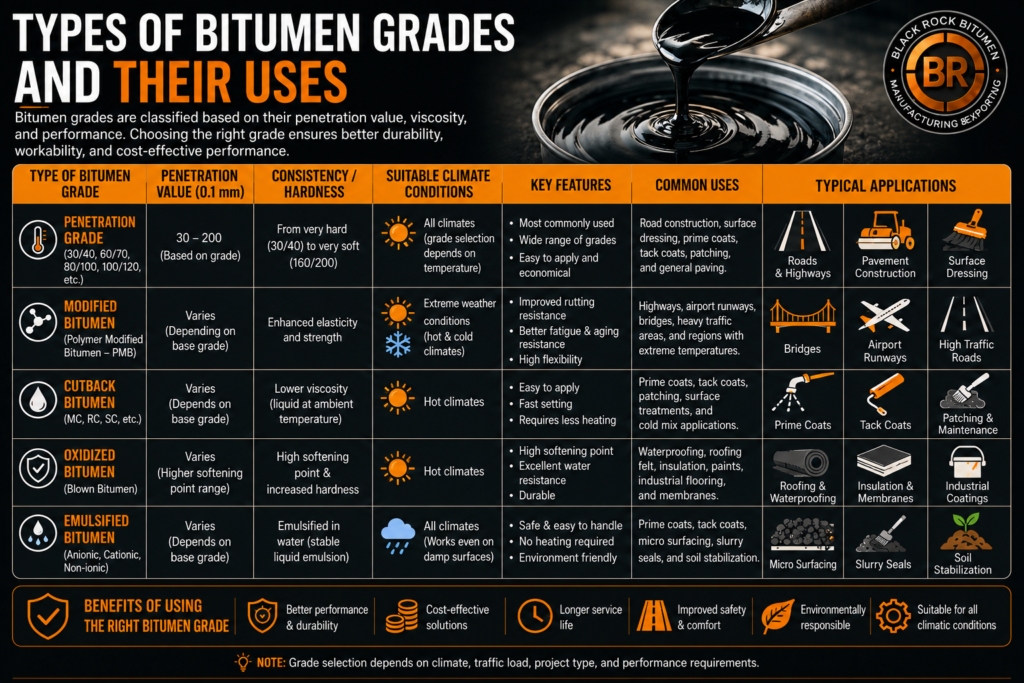
Ask three suppliers for a grade recommendation and you might get three different answers using three different numbering systems — a penetration grade, a viscosity grade, and a Performance Grade all describing binders that could be nearly identical in the field. That’s not suppliers being difficult. It’s because bitumen has been graded by more than one method over the past century, and different regions, specifications, and industries settled on different systems rather than one universal standard.
Understanding which system you’re looking at — and what the numbers inside it actually mean — is the difference between comparing two spec sheets accurately and comparing apples to oranges. For buyers sourcing across Africa, South America, and Southeast Asia specifically, this matters more than it might in a single-standard domestic market: a project can involve a local specification written against one system, an imported binder tested against another, and a contractor more familiar with a third. Here’s a breakdown of the major grading systems in active use today, what each one measures, and where each one fits.
Why Multiple Grading Systems Exist
The oldest and simplest system, penetration grading, dates back to the early 1900s and measures how far a needle sinks into a bitumen sample at a fixed temperature. It’s fast and cheap, which is exactly why it became the global default — but it only tells you about behavior at one specific temperature, 25°C, which isn’t necessarily the temperature that matters most for your climate or your project.
Viscosity grading emerged later as researchers looked for a more direct way to predict how bitumen would actually behave at the temperatures that matter for construction and in-service performance — specifically 60°C, close to a hot pavement surface in summer. Performance Grading came later still, developed under the U.S. Strategic Highway Research Program specifically to tie binder selection directly to the actual high and low temperature extremes a pavement needs to survive, rather than relying on an indirect proxy measurement at all.
Each system solved a real limitation in the one before it. None of them fully replaced the others — which is why all three are still in active use, sometimes even on the same project.
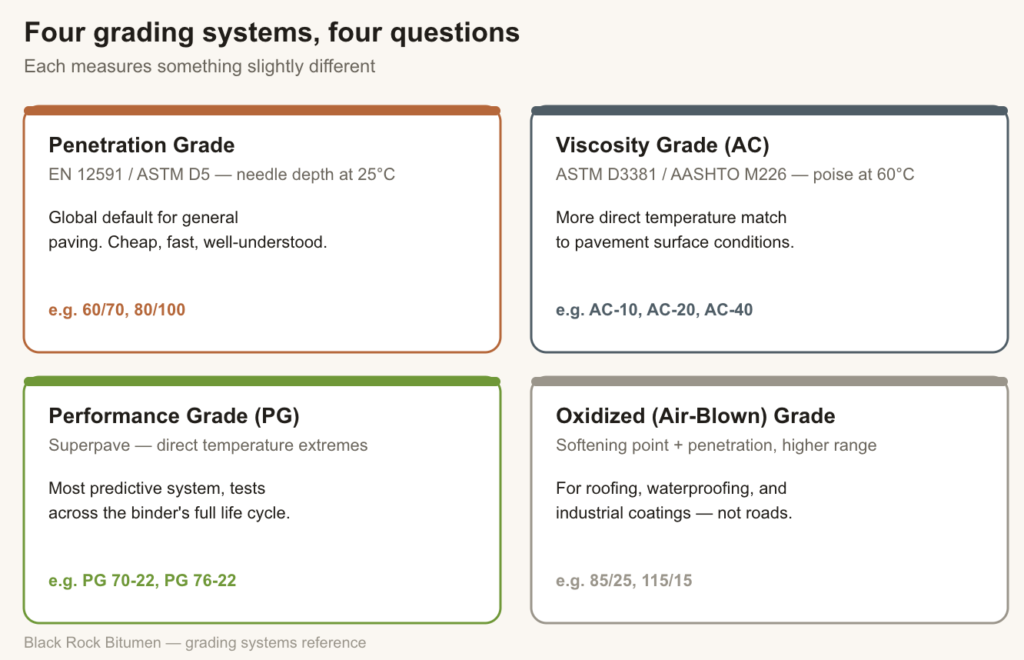
Alt text: Infographic comparing four bitumen grading categories: Penetration Grade, Viscosity Grade (AC), Performance Grade (PG), and Oxidized (Air-Blown) Grade, with the property each system measures and example grades.
Penetration Grade
Penetration grading measures how far a standard needle sinks into a bitumen sample at 25°C, expressed in tenths of a millimeter. Grades under EN 12591 include commonly traded grades from 20/30 through 250/330, with 20/30 among the hardest and 250/330 among the softer grades. Black Rock Bitumen carries the full range on our Penetration Grade Bitumen page.
| Grade | Penetration (0.1mm) | Softening point | Typical use |
| 20/30 | 20–30 | 55–63°C | Extreme heat, heavy traffic |
| 35/50 | 35–50 | 50–58°C | Hot climates, high-traffic roads |
| 50/70 | 50–70 | 46–54°C | The most widely traded grade globally |
| 70/100 | 70–100 | 43–51°C | Moderate climates |
| 160/220 | 160–220 | 35–43°C | Cold climates, low traffic |
| 250/330 | 250–330 | 30–38°C | Soft paving applications; check project standard |
This system is still the global default for paving-grade bitumen across most of Africa, the Middle East, and Southeast Asia, largely because it’s inexpensive to test and well understood by contractors and inspectors alike.
Viscosity Grade (AC System)
Viscosity grading, standardized under ASTM D3381 and AASHTO M226, measures the absolute viscosity of the bitumen at 60°C — a temperature chosen specifically because it approximates the maximum pavement surface temperature during summer, rather than the arbitrary 25°C used in penetration testing (Pavement Interactive). The result is measured in poise, and six standard grades were established:
| Grade | Target viscosity at 60°C | Relative hardness |
| AC-2.5 | 250 poise | Softest |
| AC-5 | 500 poise | Soft |
| AC-10 | 1,000 poise | Medium |
| AC-20 | 2,000 poise | Medium-hard |
| AC-30 | 3,000 poise | Hard |
| AC-40 | 4,000 poise | Hardest |
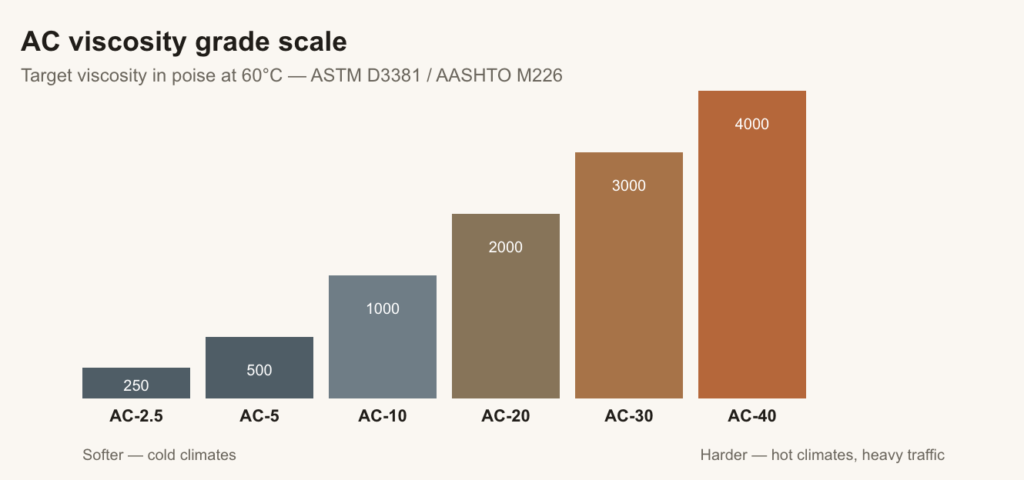
Alt text: Bar chart showing AC viscosity grades from AC-2.5 to AC-40, with target viscosity at 60°C increasing from 250 to 4,000 poise and hardness progressing from softest to hardest.
The AC system is now largely a legacy grading framework in the United States; modern U.S. binder specifications are primarily based on Performance Grade (PG) grading.
Low-viscosity grades like AC-2.5 and AC-5 suit cold climates, while the higher grades — AC-20 and up — are generally reserved for hot climates and heavy traffic, following the same underlying logic as penetration grading but measured more directly at a temperature closer to real pavement conditions. A parallel AR (Aged Residue) series grades bitumen after simulated aging rather than in its original state, giving a second data point on how the binder performs once it’s already been through mixing and laydown.
Viscosity grading is considered a more direct predictor of field behavior than penetration grading precisely because 60°C sits much closer to real pavement service temperatures than the 25°C penetration baseline — which is why some specifications call for it specifically on high-traffic or extreme-climate projects even where penetration grading remains the regional default for general use.
Viscosity Grade (Indian VG System)
India uses its own viscosity-grading framework under IS 73:2013, with VG-10, VG-20, VG-30, and VG-40 graded primarily by absolute viscosity at 60°C. The grades correspond to 800–1,200, 1,600–2,400, 2,400–3,600, and 3,200–4,800 poise respectively. The system also specifies properties such as penetration at 25°C and softening point, but the VG designation itself is based on the viscosity range. This is related to the AC system but is not the same grading designation, so an Indian specification should be read against IS 73:2013 rather than assuming an AC label applies.
Performance Grade (PG)
Performance Grading skips indirect proxy measurements entirely and grades bitumen directly against the temperature extremes it needs to survive. A PG 76-22 binder is rated to resist rutting at pavement temperatures up to 76°C and resist low-temperature cracking down to -22°C. Rather than testing at one fixed point, PG binders are evaluated across their full service life — fresh, after simulated short-term aging from mixing and laying, and after simulated long-term aging from years in service — using tests like dynamic shear rheometry and bending beam stiffness.
Worked PG selection example
Suppose a major highway project has a design high pavement temperature of 76°C, a design low temperature of -22°C, and heavy or channelized traffic. PG 76-22 is a logical starting point because the first number addresses the high-temperature rutting requirement and the second addresses the low-temperature cracking requirement. The final grade should still be confirmed against the project’s governing PG specification, climate data, traffic level, and any required grade adjustments.
This system requires more sophisticated lab equipment than penetration or viscosity grading, which is why it tends to show up on larger, higher-specification projects — major highways, airports, and routes carrying unusually heavy or channelized traffic — rather than as the universal default. It’s also the system best suited to climates with genuinely wide swings between summer heat and winter cold, since the grade number itself encodes both extremes directly.
Oxidized (Air-Blown) Grade
A fourth category exists specifically outside road paving: oxidized bitumen, produced by blowing hot air through straight-run bitumen to raise its softening point well above any paving grade. These grades — commonly ranging from around 75/25 up to 115/15 — are built for roofing, waterproofing membranes, and industrial coatings rather than road surfaces, where resistance to flow at sustained high temperatures matters more than load-bearing performance under traffic.
Comparing the Systems
These grading systems don’t map onto each other with mathematical precision — a penetration grade and a viscosity grade measure genuinely different properties at different temperatures, so treating them as directly interchangeable is a mistake. That said, it helps to think of them in rough hardness tiers rather than as unrelated numbers:
| Hardness tier | Penetration grade | Viscosity (AC) grade | Typical fit |
| Softest | 160/220 | AC-2.5 | Cold climates, low traffic |
| Soft-medium | 70/100 | AC-10 | Moderate climates |
| Medium-hard | 50/70 | AC-20 | Most widely used tier globally |
| Hard | 35/50 | AC-30 | Hot climates, higher traffic |
| Hardest | 20/30 | AC-40 | Extreme heat, heavy traffic |
Treat this as a starting orientation, never as a substitution table. If a contract specifies a viscosity grade, ordering the “roughly equivalent” penetration grade instead can still fail an inspection, because the two systems test different properties under different conditions.
Choosing the Right System for Your Project
Follow the contract or local standard first. If a tender specifies EN 12591 penetration grades, that’s what gets ordered — don’t substitute a viscosity or PG equivalent without written approval, even if the underlying hardness is similar.
Use viscosity or PG grading for higher-stakes projects. Major highways, airports, and routes with unusually heavy or channelized traffic benefit from the more direct temperature-based prediction these systems provide, assuming your project’s testing infrastructure and budget support it.
Default to penetration grading for general paving. It remains the most widely available, most affordable, and most universally understood system across the regions this guide is written for — which is exactly why it stays the practical default outside of high-specification projects.
Match oxidized grades to roofing and waterproofing, never to roads. The softening points involved are calibrated for a completely different temperature and stress environment than pavement.
Frequently Asked Questions
Which bitumen grading system is most commonly used? Penetration grading remains the most widely used system globally for general paving, largely due to its low testing cost and long track record. Viscosity and Performance Grade systems are more common on higher-specification projects.
Can I substitute a penetration grade for an equivalent viscosity grade? Not without approval. The two systems measure different properties at different temperatures, and even a close hardness match doesn’t guarantee equivalent field performance. Always follow the exact standard specified in your contract.
What’s the main advantage of Performance Grade over the other systems? PG grading ties the binder directly to the actual high and low temperature extremes it needs to survive, and evaluates it across multiple stages of aging rather than a single snapshot — making it the most predictive system, though also the most testing-intensive.
Is oxidized bitumen graded the same way as paving bitumen? It uses a similar softening-point-plus-penetration notation, but the values sit in a completely different range, calibrated for roofing and waterproofing temperature exposure rather than road traffic.
Related Reading
For readers moving from grade selection into specification and sourcing, see our Bitumen 60/70 vs. 80/100 guide and our Bitumen Blog for related technical and procurement guidance.
The Bottom Line
There isn’t one “correct” bitumen grading system — there’s the system your contract, region, or project specification calls for, and the discipline to not treat different systems as interchangeable just because the numbers look similar. Know which system you’re reading, understand what it actually measures, and match your order to the exact standard your project requires.
Black Rock Bitumen supplies across all four grading systems covered here — see our Penetration Grade Bitumen, Performance Grades, and Oxidized Bitumen ranges, or our Polymer Modified Bitumen line for projects that need more than a base grade can offer on its own.