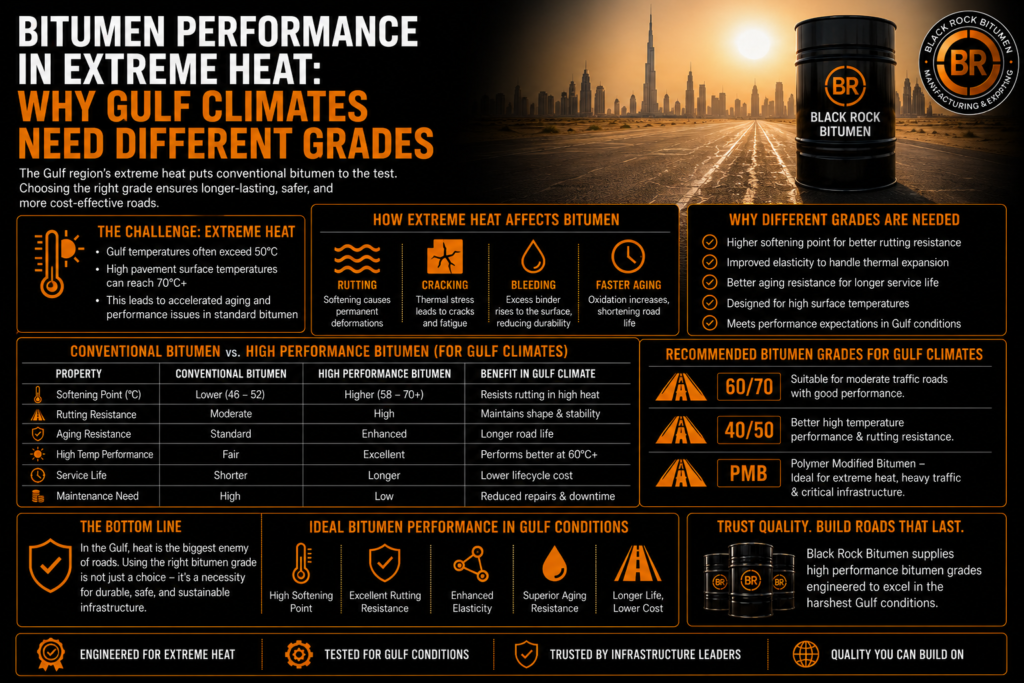
In Gulf road projects, the question is not simply whether a bitumen grade can survive a hot day. The real question is whether the binder has been selected for the pavement temperature, traffic loading, project specification and mixture design it will actually face.
Pavement temperature can differ substantially from air temperature. Published Gulf and Saudi research reports seven-day maximum pavement design temperatures reaching around 76°C in parts of the region. King Fahd University research found that more than half of Gulf areas experience maximum seven-consecutive-day pavement temperatures of 76°C. This makes temperature-based binder selection particularly important in Gulf infrastructure.
But that does not mean every Gulf road automatically needs the highest grade available. The right grade is the one that satisfies the project’s actual temperature, traffic, reliability and specification requirements.
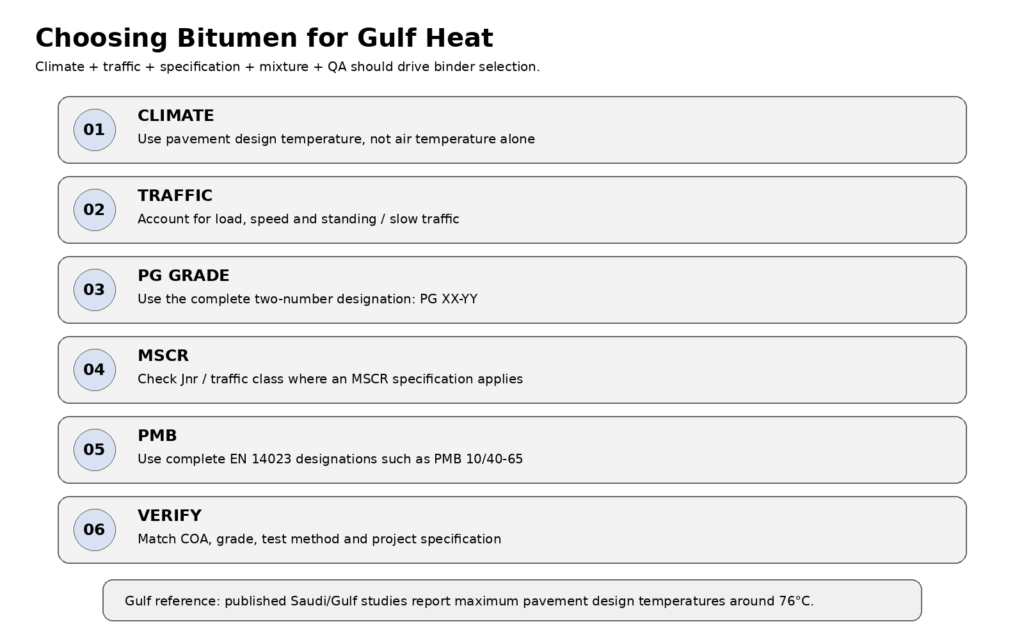
Alt text: Infographic showing six steps for selecting bitumen in Gulf heat: climate, traffic, complete PG grade, MSCR, PMB designation and verification against the project specification.
How Hot Can a Gulf Road Pavement Get?
Air temperature is only part of the calculation. Solar radiation, pavement surface characteristics and heat stored in the pavement influence the temperature experienced by the binder. Performance-grade systems therefore work from pavement design temperatures rather than simply copying the maximum air temperature.
Research from King Fahd University of Petroleum and Minerals reports that more than 50% of Gulf areas experience a maximum seven-day pavement temperature of 76°C.
Saudi-focused research also reports seven-day maximum pavement temperatures ranging from 64°C to 76°C, with different regions requiring different high-temperature binder grades.
What the PG Numbers Actually Mean
Performance Grade bitumen is expressed as PG XX-YY. The first number represents the high pavement design temperature; the second represents the low pavement design temperature. A complete designation needs both numbers.
| Full PG designation | High grade | Low grade | Gulf relevance |
| PG 64-10 | 64°C | -10°C | Warm-climate applications where the project calculation supports it |
| PG 70-10 | 70°C | -10°C | Higher-temperature Gulf applications |
| PG 76-10 | 76°C | -10°C | High-temperature Gulf applications reaching around 76°C |
| PG 76-16 | 76°C | -16°C | High-temperature applications with the specified lower low-temperature requirement |
| PG 82 — incomplete | 82°C | Must be stated | Never write PG82 alone in a tender; verify the full designation |
The low-temperature suffix matters. Gulf-specific work should not simply import a North American table filled with -22°C suffixes when the project’s actual low-temperature design requirement is -10°C or -16°C.
Black Rock Bitumen’s current performance-grade page lists PG70, PG76 and PG82 product families and gives complete examples such as PG-76-10 and PG-76-16.
The Grade-Sum Check: A Useful Buyer Shortcut
A practical heuristic is to add the absolute values of the high and low PG numbers. A sum above roughly 90 is a strong indication that the binder is polymer-modified, because conventional straight-run binders generally do not cover such a wide performance range.
| Example | Grade sum | Interpretation |
| PG 64-10 | 74 | Consistent with an unmodified binder |
| PG 70-10 | 80 | Sum alone does not prove modification |
| PG 76-10 | 86 | Sum alone does not prove modification |
| PG 76-16 | 92 | Strong indication of a modified / high-performance binder |
| PG 76-22 | 98 | Strong indication of a modified / high-performance binder |
This is a shortcut, not a specification requirement. Confirm modification and compliance through the governing specification and COA.
For a deeper comparison, see Bitumen vs. Polymer Modified Bitumen (PMB) — Which to Use When.
Why Heat Causes Rutting
As binder temperature rises, asphalt becomes softer. Under repeated wheel loading, a binder that lacks sufficient resistance to permanent deformation can contribute to rutting. The risk increases when heavy vehicles move slowly or stop repeatedly at intersections, bus lanes, ports and approaches.
That is why temperature alone should never determine the binder. The selection needs to reflect both the thermal environment and the loading environment.
MSCR: The Modern Way to Account for Heavy Traffic
Multiple Stress Creep and Recovery (MSCR) evaluates binder recovery and non-recoverable creep under repeated loading. AASHTO M 332 uses MSCR and T 350 to determine non-recoverable creep compliance, Jnr, with traffic classes for standard, heavy, very heavy and extremely heavy loading.
See AASHTO M 332 for the MSCR-based performance-grade framework.
ASTM D8239 provides the ASTM MSCR specification and uses S, H, V and E designations for standard, high, very high and extremely high traffic loading.
See ASTM D8239 for the current MSCR specification listing.
The underlying MSCR test is ASTM D7405; it determines percent recovery and non-recoverable creep compliance using a dynamic shear rheometer.
Where the project specifies an MSCR framework, buyers should check the traffic class and Jnr requirement instead of relying only on a generic high-temperature grade bump.
Grade Bumping vs. Performance-Based Selection
Traditional practice often used high-temperature grade bumping to account for slow or heavy traffic. Modern MSCR specifications provide a more direct performance framework by evaluating non-recoverable creep and recovery under defined stress levels.
For a Gulf project, follow the governing specification. If it requires AASHTO M 332 or ASTM D8239, use that framework. If it specifies conventional PG grading with traffic-based adjustments, follow the stated project method. Do not mix systems casually.
Does Every Gulf Road Need PG 82?
No. A supplier may offer very high-performance grades, but the highest available grade is not automatically the right grade.
Over-specification can increase material cost without a meaningful project benefit when the pavement temperature, traffic and mixture do not justify it. Under-specification can leave the binder vulnerable to rutting when the pavement reaches its design temperature or traffic is slower and heavier than assumed.
The correct approach is to select the lowest grade that demonstrably satisfies the project’s temperature, traffic, reliability and specification requirements — then verify that mixture design and construction quality can deliver the expected performance.
Black Rock Bitumen’s performance-grade range should therefore be treated as a selection range, not a ranking in which PG82 is automatically better than PG76 or PG70.
What Is the Role of PMB in Gulf Heat?
Polymer Modified Bitumen can improve resistance to permanent deformation and provide a wider useful performance range than conventional binder. It is particularly relevant when high pavement temperatures combine with heavy, slow or concentrated traffic.
PMB should still be selected against a specification. Under EN 14023, designations use a penetration range and softening-point requirement. PMB 10/40-65 means a penetration range of 10 to 40 (0.1 mm at 25°C) with a minimum softening point of 65°C.
An EN 14023 product example confirms the PMB 10/40-65 designation and its penetration and softening-point requirements.
For Black Rock Bitumen, use the complete designation shown in the current PMB product documentation rather than shorthand.
PG Bitumen vs. PMB: Which Should You Use?
| Project condition | Potential direction | Still needs checking |
| Moderate heat / standard traffic | Conventional PG may be sufficient | Calculated pavement temperature and specification |
| High heat / standard traffic | Higher PG may be appropriate | Full PG designation and reliability |
| High heat / heavy traffic | High PG or MSCR-qualified binder | Traffic class, Jnr / MSCR and mixture design |
| High heat / slow or standing loads | PMB or MSCR-qualified binder may be justified | Specification and storage stability |
| Extreme heat + demanding traffic | High-performance PMB / MSCR route may be required | Tender, COA and mixture performance |
This is a decision framework, not a blanket product recommendation. The project specification remains controlling.
Reliability: The Number Buyers Often Skip
Reliability represents the probability that the selected grade will cover the actual pavement temperature at the specified confidence level. A higher reliability level can shift the required grade upward.
That means two projects in the same city can legitimately specify different grades if they use different temperature, reliability or traffic assumptions.
What pavement design temperature was calculated?
What reliability level was used?
What traffic condition was assumed?
The Five-Step Gulf Binder Selection Framework
Climate — determine the pavement design temperature and low-temperature requirement.
Traffic — account for standard, heavy, very heavy or extremely heavy loading, including slow or standing traffic.
Specification — identify whether the project uses conventional PG, MSCR, EN PMB or another framework.
Mixture design — confirm aggregate structure, binder content, air voids and volumetrics support the selected binder.
QA and verification — check the COA, complete grade designation, test methods and batch traceability.
What Should Be on the COA?
| COA check | What to verify |
| Complete grade | PG XX-YY or complete PMB designation |
| Specification | ASTM / AASHTO / EN requirement |
| Temperature performance | Matches the specified design temperature |
| Low-temperature performance | Matches the specified low-temperature requirement |
| MSCR, if required | Jnr / recovery and traffic designation |
| Batch traceability | Batch number matches shipment |
| Test methods | Methods match the governing specification |
| Documentation | COA, TDS and SDS are consistent |
For the full certificate-reading process, see How to Read a Bitumen COA Line by Line.
Common Mistakes in Hot-Climate Bitumen Selection
• Choosing a binder because the country is hot without calculating pavement design temperature.
• Using a PG grade without the low-temperature suffix.
• Copying North American low-temperature suffixes into Gulf specifications without checking the project’s design temperature.
• Assuming PG82 is automatically better than PG76.
• Ignoring traffic speed and load duration.
• Using conventional PG where the project specifies MSCR.
• Treating the grade-sum heuristic as proof of polymer modification.
• Writing shorthand such as PG76 instead of the complete designation.
• Specifying PMB by product name without the governing EN 14023 grade.
• Checking the binder while ignoring mixture design and construction quality.
How Black Rock Bitumen Fits Into the Gulf Supply Chain
Black Rock Bitumen is Dubai-based and supplies performance-grade bitumen for projects across Africa, Asia and the Middle East. Its current performance-grade page lists PG70, PG76 and PG82 families and includes full designations such as PG-76-10 and PG-76-16.
See the current Performance Grade Bitumen range for complete product designations.
For the wider framework, see Regulatory Standards for Bitumen (ASTM, BIS, EN).
For binder selection, see Bitumen vs. Polymer Modified Bitumen (PMB) — Which to Use When .
For related pavement failures, see Bleeding, Rutting and Stripping.
FAQs
Does Gulf heat automatically require PG 82?
No. Binder grade should be selected from calculated pavement temperature, reliability, traffic and specification.
What PG grades are relevant to Gulf climates?
Examples used in Gulf-focused work include PG 64-10, PG 70-10, PG 76-10 and PG 76-16. The exact grade should come from the project’s design.
Why is PG 76 important in Gulf projects?
Published Gulf and Saudi studies report maximum seven-day pavement design temperatures reaching around 76°C in parts of the region.
What is MSCR?
Multiple Stress Creep and Recovery evaluates binder recovery and non-recoverable creep under repeated loading and is used in AASHTO M 332 and ASTM D8239 frameworks.
What does PG 76-10 mean?
It indicates a 76°C high-temperature grade and a -10°C low-temperature grade.
What does PMB 10/40-65 mean?
Under EN 14023, it indicates a penetration range of 10 to 40 and a minimum softening point of 65°C.
Is the grade-sum rule a specification requirement?
No. It is only a heuristic; confirm modification through the governing specification and COA.
The Bottom Line
Extreme heat changes the binder selection equation.
For Gulf roads, the objective is not simply to buy a harder bitumen. The objective is to select a binder that can maintain the required performance at the pavement temperatures and traffic loads the road will actually experience.
That may mean a conventional penetration or viscosity grade for one project, a higher-performance PG binder for another, or a polymer-modified binder where the traffic and temperature demands justify it.
The strongest approach is to start with the engineering requirement, not the product catalogue: establish pavement temperatures, assess traffic, select the appropriate specification, validate the asphalt mixture, and then verify the delivered binder through quality-control testing.
For procurement teams, start with Bitumen Grades & Standards for Infrastructure Tenders and then review Performance Grade Bitumen to understand the PG system. For extreme-heat and heavy-traffic applications, compare the relevant PG82 and PG76 options, and review Polymer Modified Bitumen where modification is specified. Before approving a shipment, use the COA documentation process to verify that the delivered binder matches the project requirement.