


No products in the cart.
- Blog
- Grades & specs
- Bitumen 60/70 Specification: Full Property Table, Test Methods and Where It Is Used
Bitumen 60/70 Specification: Full Property Table, Test Methods and Where It Is Used
Specification checked 16 Nov 2026 Grades & specs

Saniya MirzaBlack Rock Bitumen · Dubai, UAE
10 min read
Table of contents
- What is Bitumen 60/70?
- What does “60/70” mean?
- Bitumen 60/70 specification table
- What each property tells a buyer
- Which standards cover Bitumen 60/70?
- What is the density of Bitumen 60/70?
- Where is Bitumen 60/70 used?
- How should Bitumen 60/70 be stored and handled?
- Bitumen 60/70 vs 80/100, 50/70 and VG-30
- Packaging, HS code and shipping documents
- How are bitumen drums loaded for export?
- Bitumen 60/70 specification PDF, TDS and MSDS
- What should you check before ordering Bitumen 60/70?
- Frequently asked questions
- Get a quote for Bitumen 60/70
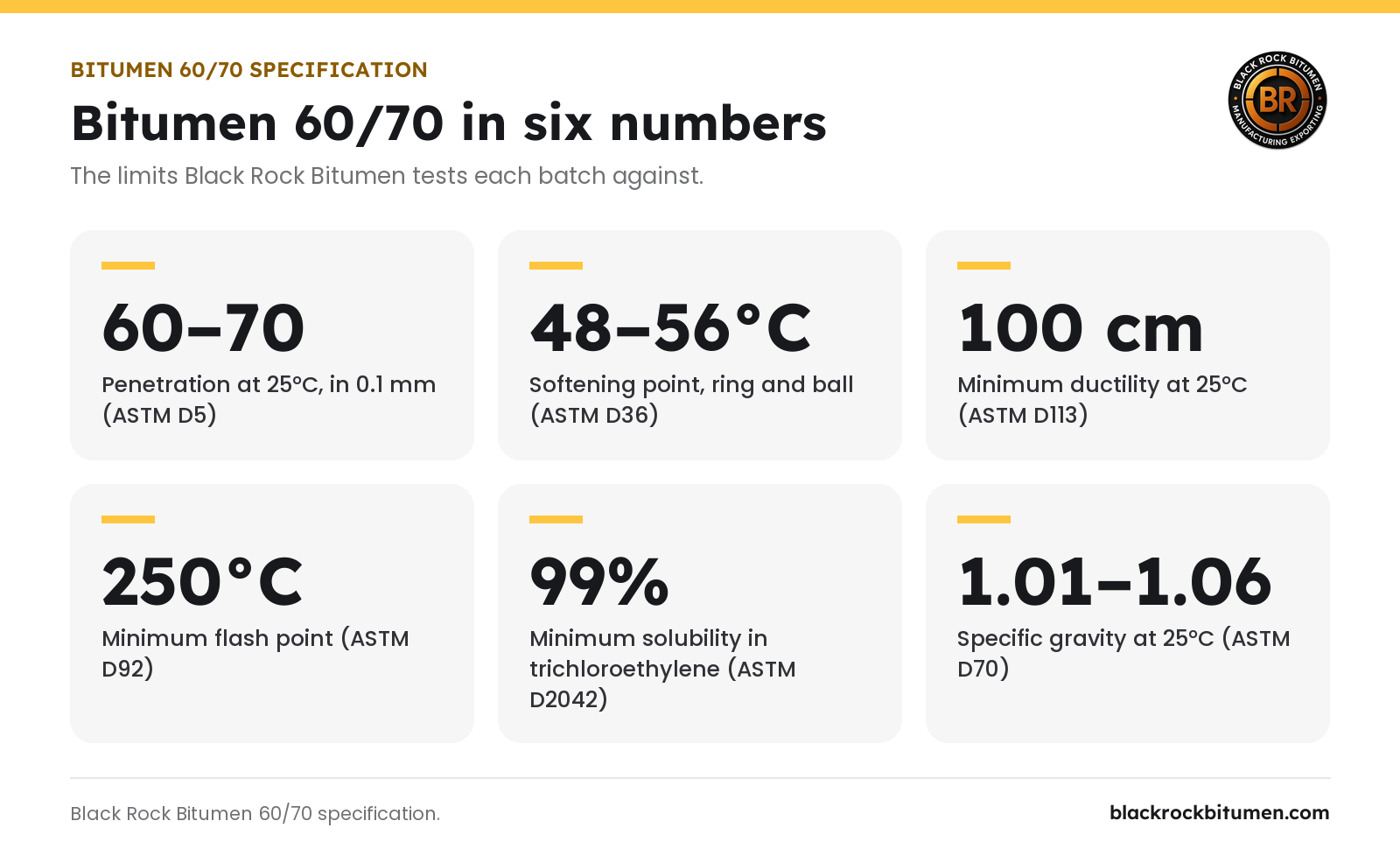
Short answer: Bitumen 60/70 is a penetration grade paving bitumen whose penetration at 25°C falls between 60 and 70 tenths of a millimetre (6 to 7 mm). The Bitumen 60/70 specification supplied by Black Rock Bitumen also requires a softening point of 48 to 56°C, ductility of at least 100 cm, a flash point of at least 250°C and solubility of at least 99%.
- Grade type: penetration grade bitumen, classified under ASTM D946.
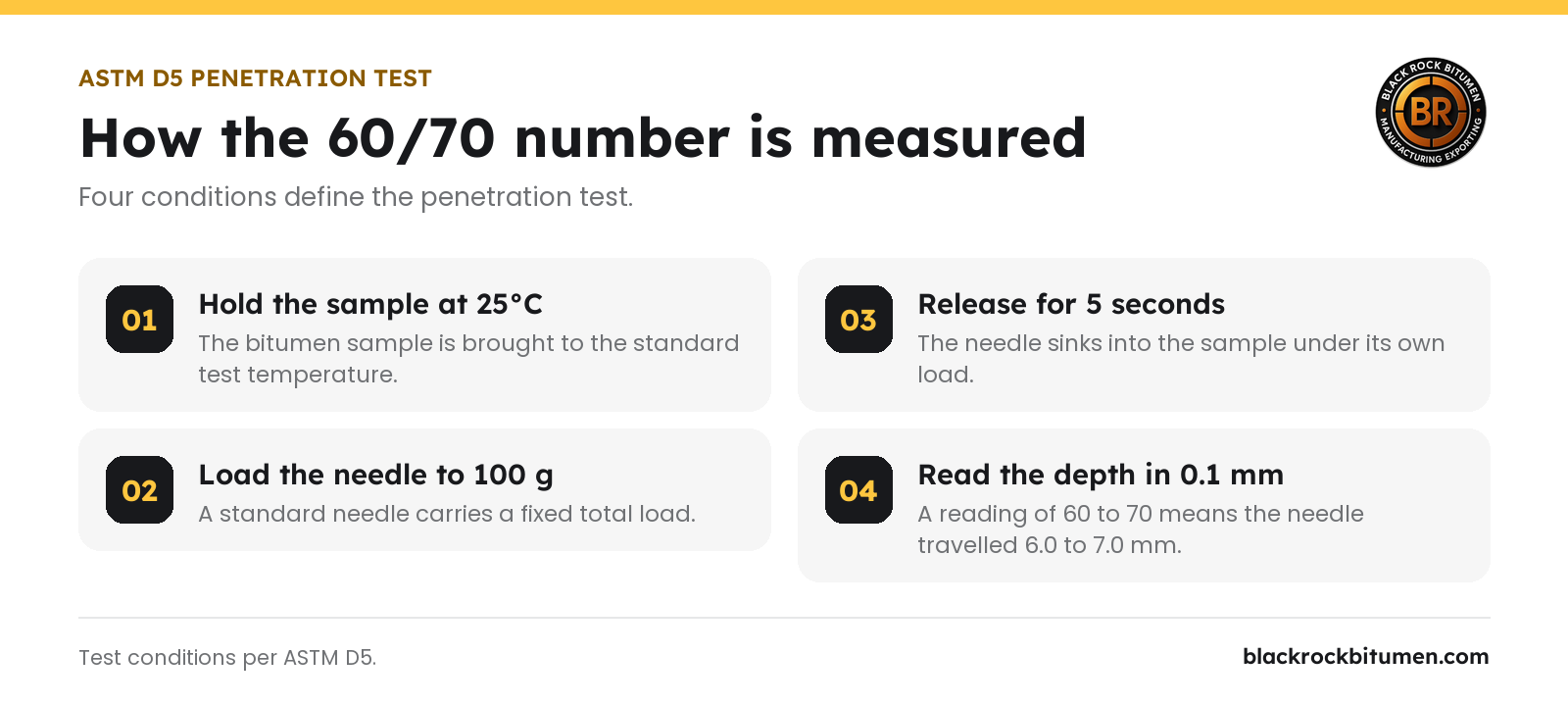
- What “60/70” means: a standard needle sinks 6.0 to 7.0 mm into the sample at 25°C under a 100 g load in 5 seconds.
- Where it fits: hot-mix asphalt for highways, urban roads and airport pavements in moderate to warm climates.
- Density: specific gravity of 1.01 to 1.06 at 25°C, which is about 1,010 to 1,060 kg/m³.
- HS code: 27132000.
- Documents: every Black Rock Bitumen shipment includes a Certificate of Analysis and an MSDS.
What is Bitumen 60/70?
Bitumen 60/70 is a medium-hardness petroleum bitumen produced from the vacuum residue of crude oil and graded by the penetration test. It is harder than Bitumen 80/100 and softer than Bitumen 40/50, which is why it is the default paving binder in much of the Middle East, Africa and South and Southeast Asia.
The grade balances two things a road needs. It is stiff enough to resist rutting when the pavement gets hot, and flexible enough to resist cracking under repeated traffic loads. For how the full grade ladder works, see our bitumen penetration grade chart and our overview of the types of bitumen grades and their uses.
What does “60/70” mean?
The two numbers are the minimum and maximum penetration values allowed for the grade. In the penetration test (ASTM D5), a standard needle loaded to 100 g is released onto a bitumen sample held at 25°C for 5 seconds. The depth it sinks is reported in units of 0.1 mm.
A result between 60 and 70 means the needle travelled 6.0 to 7.0 mm. A lower number means a harder bitumen. A higher number means a softer one.
Bitumen 60/70 specification table
This is the specification Black Rock Bitumen tests each batch of Bitumen 60/70 against before shipment.
| Property | Test method | Unit | Min | Max |
|---|---|---|---|---|
| Specific gravity at 25°C | ASTM D70 | – | 1.01 | 1.06 |
| Penetration at 25°C, 100 g, 5 s | ASTM D5 | 0.1 mm | 60 | 70 |
| Softening point | ASTM D36 | °C | 48 | 56 |
| Ductility at 25°C | ASTM D113 | cm | 100 | – |
| Loss on heating | ASTM D6 | wt.% | – | 0.2 |
| Drop in penetration after heating | ASTM D5 | % | – | 20 |
| Flash point | ASTM D92 | °C | 250 | – |
| Solubility in trichloroethylene | ASTM D2042 | wt.% | 99 | – |
| Spot test | AASHTO T102 | – | Negative | – |
The same table, with packing and supply terms, is on the Bitumen 60/70 product page.
What each property tells a buyer
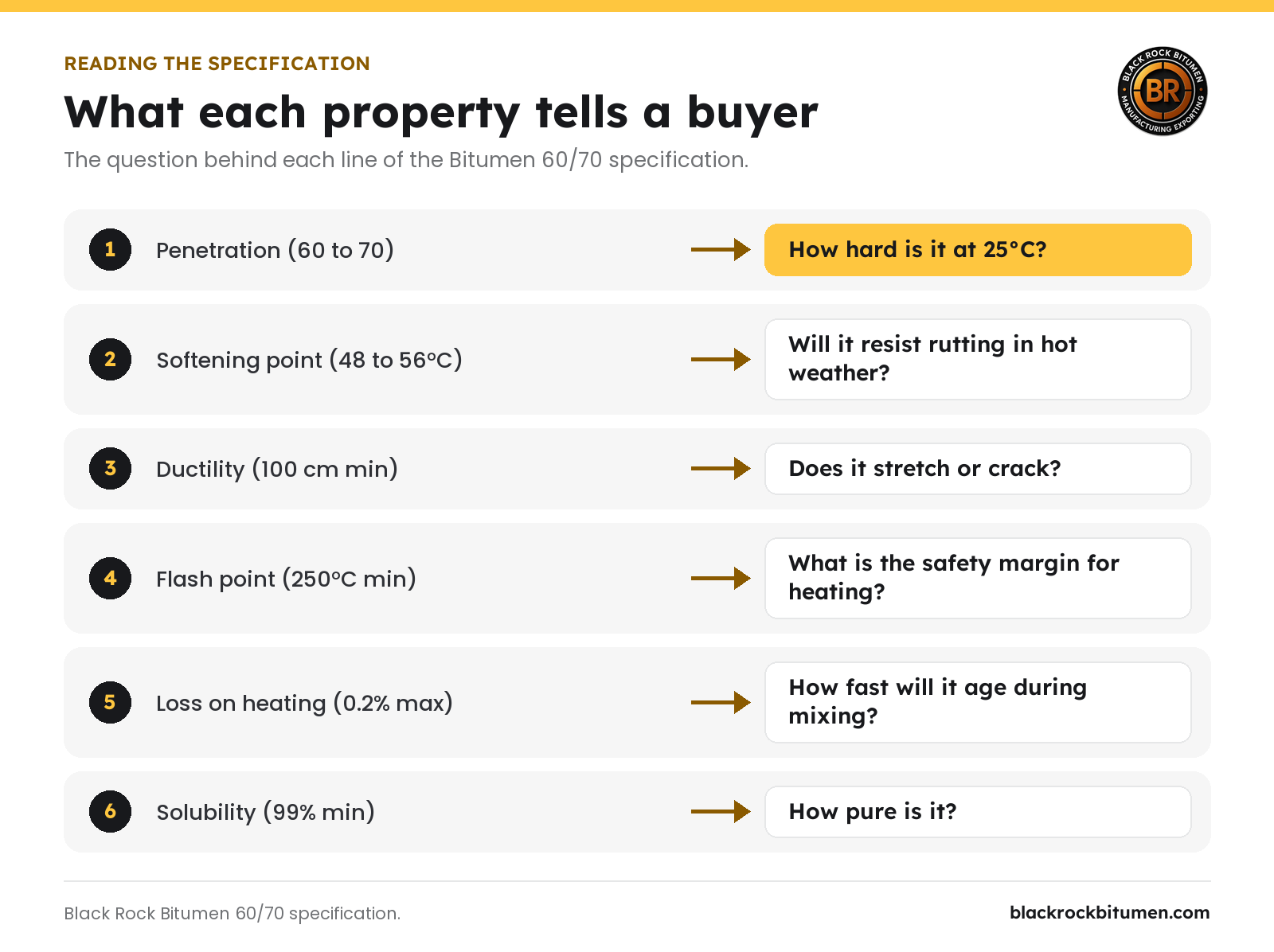
Each line of the specification answers a practical question about how the bitumen will behave in the plant and on the road.
- Penetration tells you the hardness at 25°C. It is the property that defines the grade.
- Softening point tells you the temperature at which the bitumen starts to flow. A higher value means better resistance to rutting and bleeding in hot weather.
- Ductility tells you how far the bitumen stretches before it breaks. At least 100 cm indicates a binder that holds together under movement instead of cracking.
- Flash point tells you the temperature at which vapours can ignite. It sets the safety margin for heating and handling.
- Loss on heating and drop in penetration tell you how much the bitumen hardens when it is heated. Low values mean the binder will not age too quickly during mixing.
- Solubility tells you purity. At least 99% means almost no mineral matter or contamination.
- Specific gravity is needed for converting between volume and weight in tanks, drums and mix design.
- Spot test is a screen for cracked or overheated material. The result should be negative.
For a deeper look at three of these tests, read softening point, ductility and flash point explained.
Which standards cover Bitumen 60/70?
Bitumen 60/70 is defined by ASTM D946, the standard specification for penetration-graded asphalt binder used in pavement construction. AASHTO M 20 is the matching AASHTO specification for penetration-graded binder.
Other regions grade paving bitumen differently, so the same tender can name a different standard:
- ASTM D946 and AASHTO M 20: penetration grades, including 60/70. Common in the Middle East, Africa and much of Asia.
- EN 12591: European paving grades. The closest grade is 50/70, not 60/70.
- IS 73: Indian viscosity grades. The closest grade is VG-30, tested at 60°C.
A Certificate of Analysis only proves compliance with the standard it was tested against. If your contract names EN 12591 or IS 73, ask for results under that standard. Our guide to types of bitumen grades and their uses shows where each system is used.
What is the density of Bitumen 60/70?
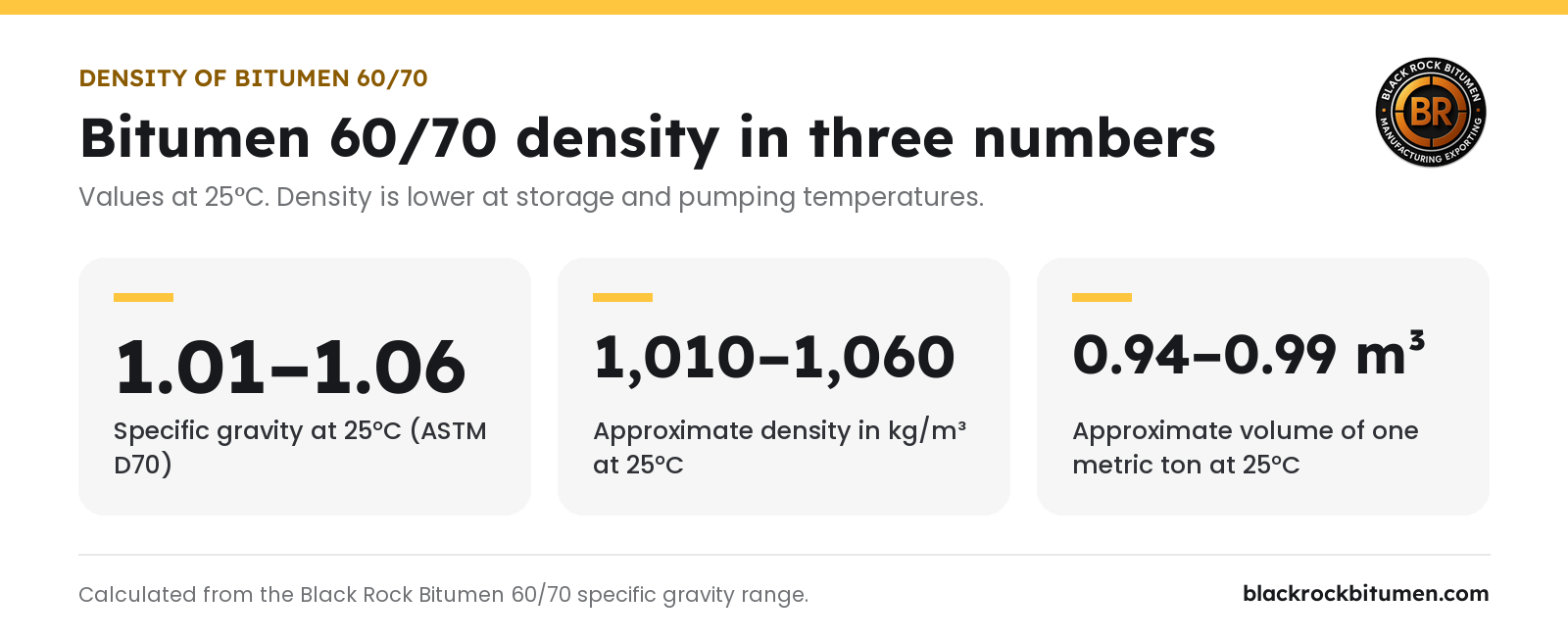
The specific gravity of Bitumen 60/70 is 1.01 to 1.06 at 25°C, which corresponds to a density of roughly 1,010 to 1,060 kg/m³. In practical terms, one metric ton occupies a little under one cubic metre at 25°C.
Bitumen expands when heated, so its density is lower at storage and pumping temperatures. Use the specific gravity on the Certificate of Analysis for your batch, corrected for temperature, when you calculate tank volumes.
Where is Bitumen 60/70 used?
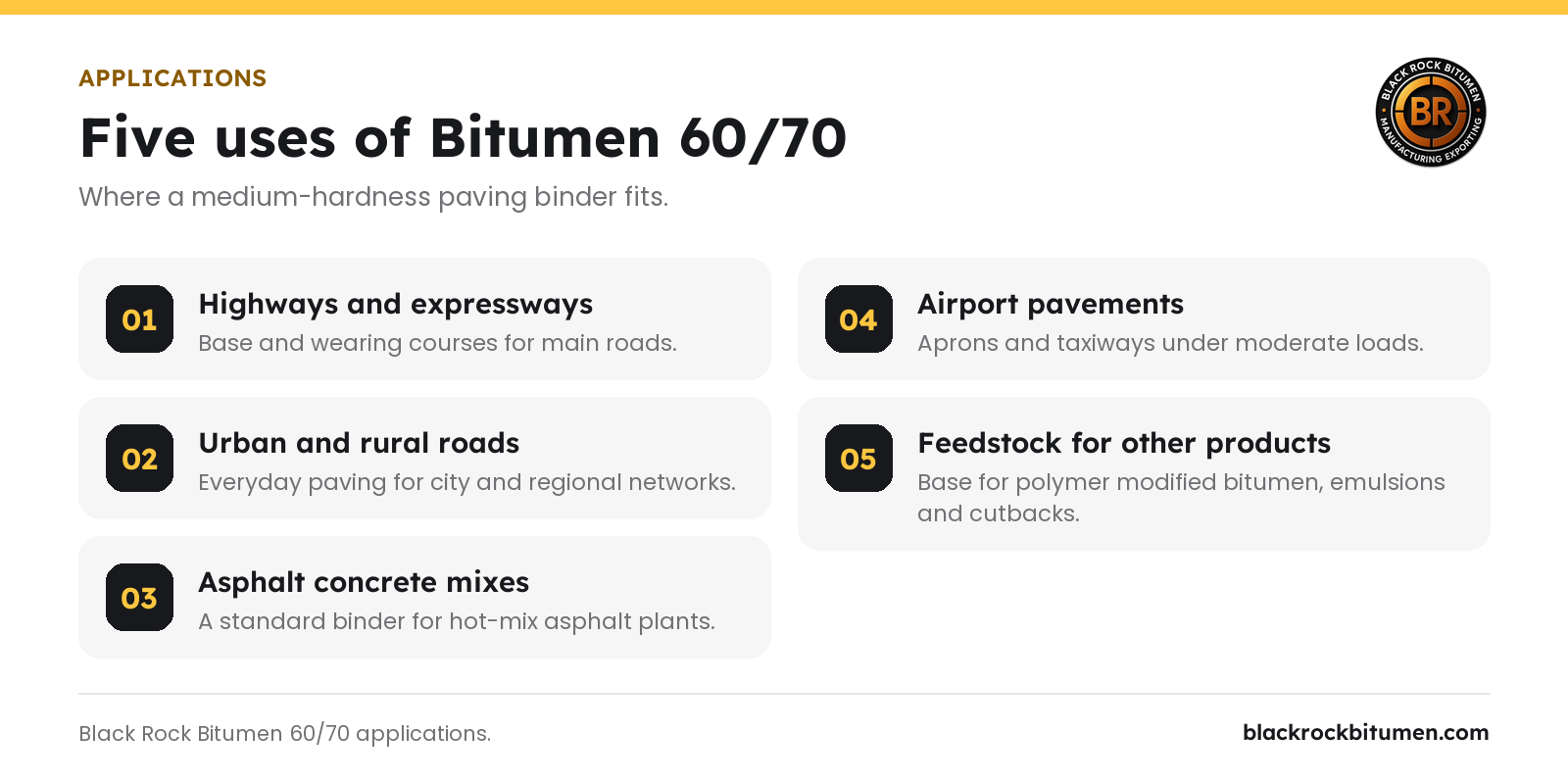
Bitumen 60/70 is used mainly as the binder in hot-mix asphalt for roads that carry medium to heavy traffic in moderate to warm climates.
- Highways and expressways: base and wearing courses for main roads.
- Urban and rural roads: everyday paving for city and regional networks.
- Asphalt concrete mixes: a standard binder for hot-mix asphalt plants.
- Airport pavements: aprons and taxiways under moderate loads.
- Feedstock for other products: a common base for polymer modified bitumen, emulsions and cutbacks.
In very hot regions with heavy, slow traffic, a harder or polymer modified binder may be the better choice. In cold regions, a softer grade such as 80/100 resists low-temperature cracking better. Our guide on choosing a bitumen grade for your climate covers the decision in detail.
How should Bitumen 60/70 be stored and handled?
Store Bitumen 60/70 at the lowest temperature that still allows safe pumping, typically 140 to 160°C for standard paving grades, and keep water out of every tank and drum.
- Tank temperature: standard paving grades top out at around 180 to 190°C. Holding bitumen hotter than it needs to be speeds up ageing before it reaches the mix.
- Water: moisture that meets hot bitumen can flash to steam and cause violent foaming. Check tanks, lines and drums are dry before heating.
- Drums: keep drums sealed and store them in dry, shaded conditions. Direct sunlight heats a drum from the inside and speeds up ageing.
- Drum shelf life: Black Rock Bitumen uses 12 to 24 months as commercial guidance for properly sealed drums stored dry and in the shade.
- Damaged drums: a dented, rusted or punctured drum can let in air and moisture. Set it aside and inspect it before reheating.
For more detail, see the shelf life of bitumen drums, common storage and handling mistakes and whether bitumen can be reheated after it cools.
Bitumen 60/70 vs 80/100, 50/70 and VG-30
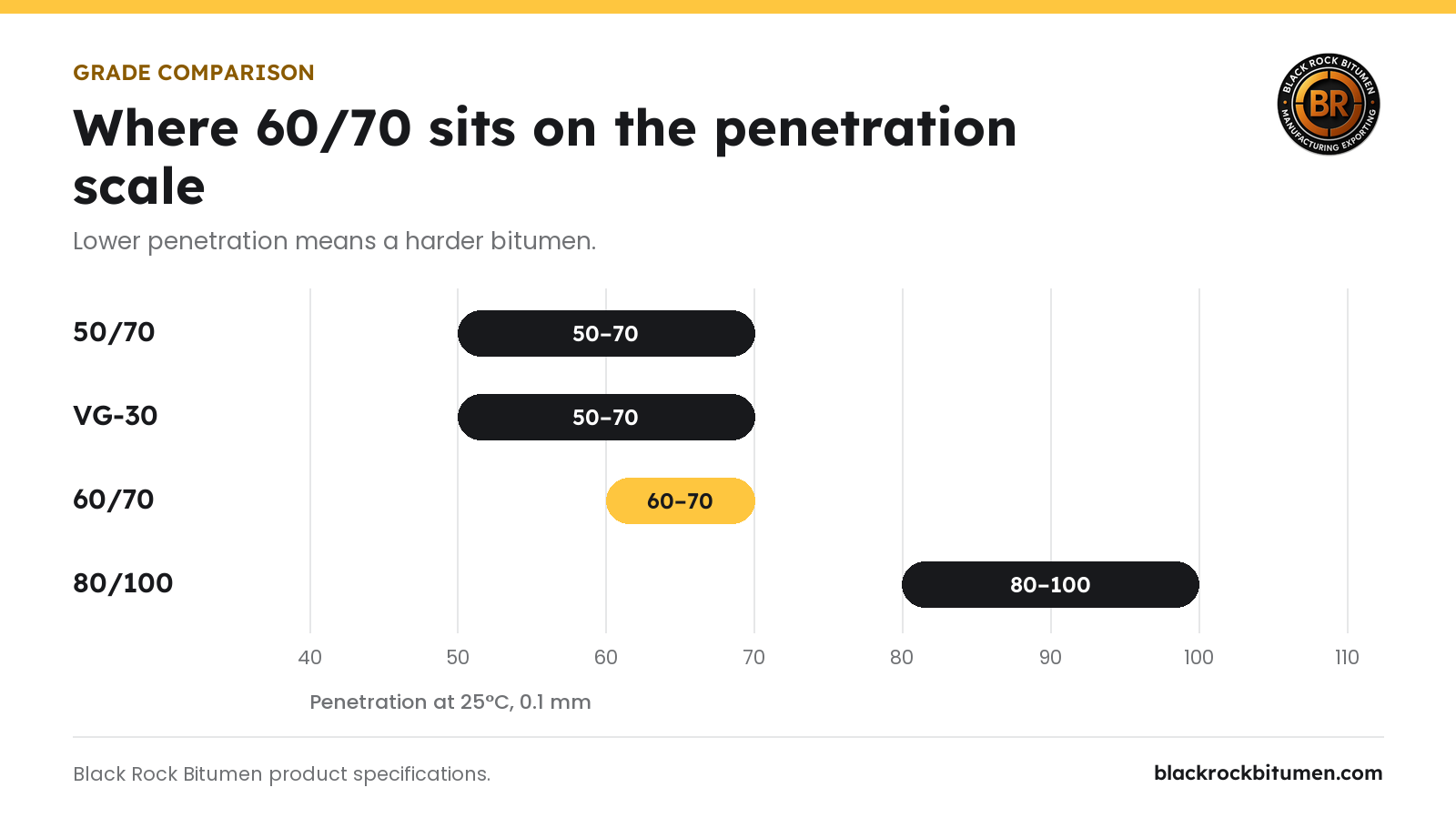
Bitumen 60/70 is harder than 80/100, very close to the European 50/70 grade, and in the same hardness range as India’s VG-30. The table compares the specifications Black Rock Bitumen supplies for each.
| Bitumen 60/70 | Bitumen 80/100 | Bitumen 50/70 | VG-30 | |
|---|---|---|---|---|
| Grading system | Penetration (ASTM D946) | Penetration (ASTM D946) | Penetration (EN 12591) | Viscosity (IS 73) |
| Penetration at 25°C, 0.1 mm | 60 to 70 | 80 to 100 | 50 to 70 | 50 to 70 |
| Softening point, °C | 48 to 56 | 42 to 50 | 46 to 54 | 47 min |
| Flash point, °C min | 250 | 250 | 230 | 220 |
| Graded by | Hardness at 25°C | Hardness at 25°C | Hardness at 25°C | Viscosity at 60°C (2,400 to 3,600 poise) |
| Typical fit | Warm climates, medium to heavy traffic | Temperate and cold climates, lighter traffic | Markets specifying EN grades | Markets specifying Indian VG grades |
Two points matter when comparing grades:
- 60/70 vs 80/100: choose 60/70 where pavement temperatures and traffic loads are higher. Choose 80/100 where flexibility in cooler weather matters more.
- 60/70 vs VG-30: the two overlap in hardness, but they are graded by different tests. A tender that calls for VG-30 needs viscosity results at 60°C, so a 60/70 Certificate of Analysis alone will not satisfy it.
Always supply the grade named in the project specification. Our overview of ASTM, BIS and EN bitumen standards explains how the systems relate.
Packaging, HS code and shipping documents
Bitumen 60/70 ships under HS code 27132000 and is exported from Dubai by Black Rock Bitumen in four packing options.
- Drums: new steel drums for secure transport and long storage.
- Jumbo bags: economical bagged bitumen for flexible handling.
- Bitutainers: high-volume bulk containers for large shipments.
- Bitubox: a bulk container option for efficient export loads.
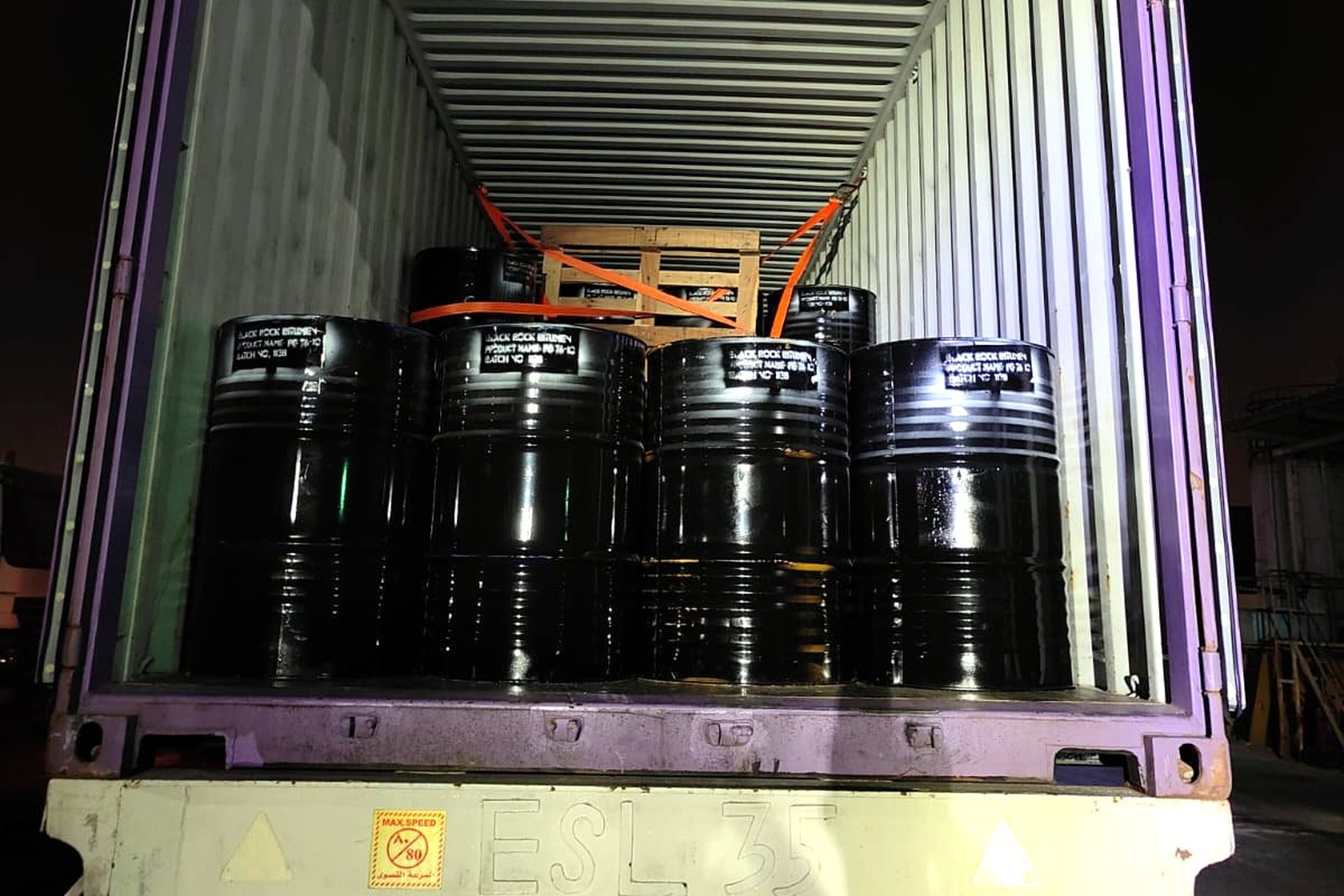
Delivery terms are FOB, CFR or CIF. For customs paperwork, see HS codes and import documentation for bitumen shipments.
How are bitumen drums loaded for export?
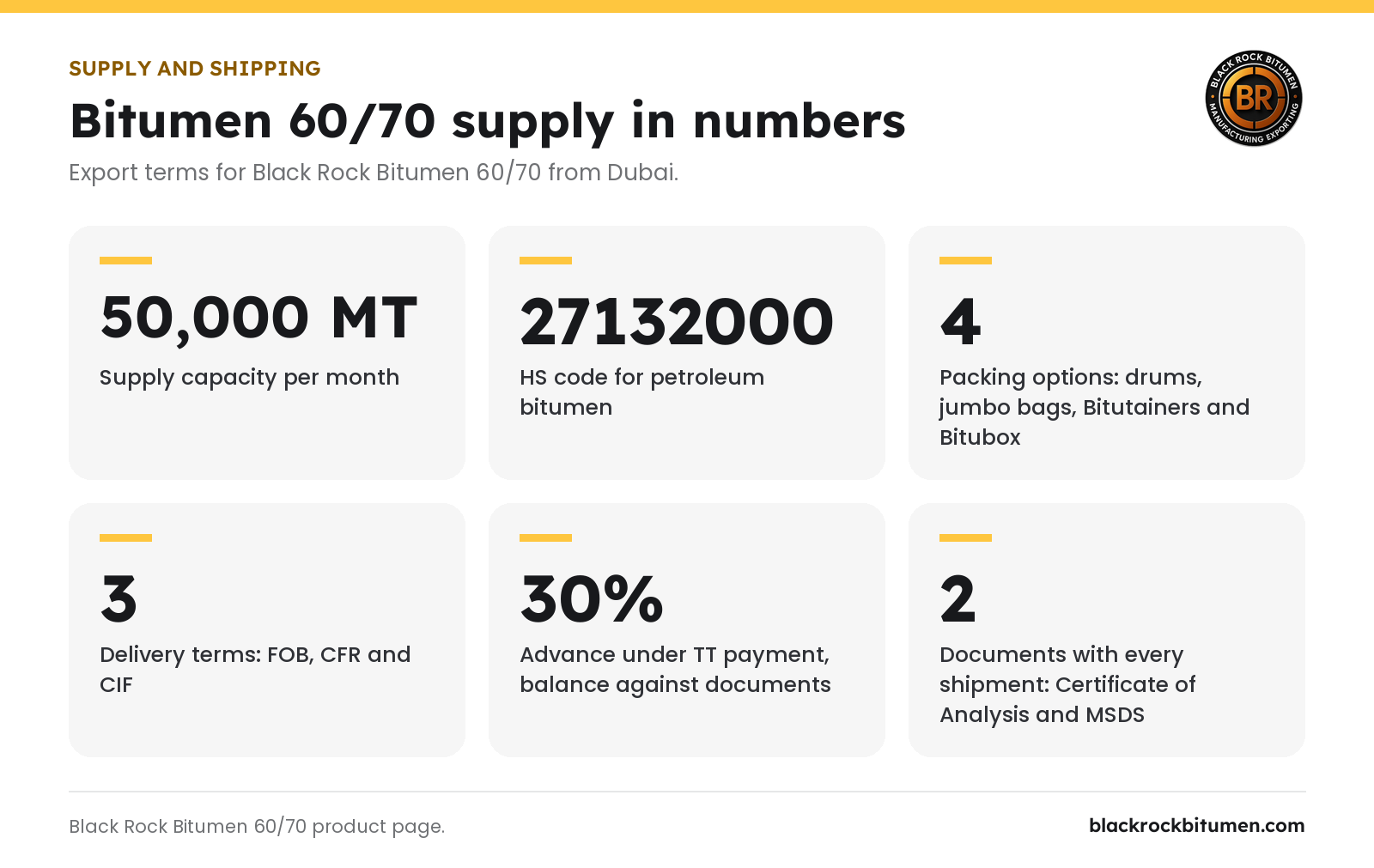
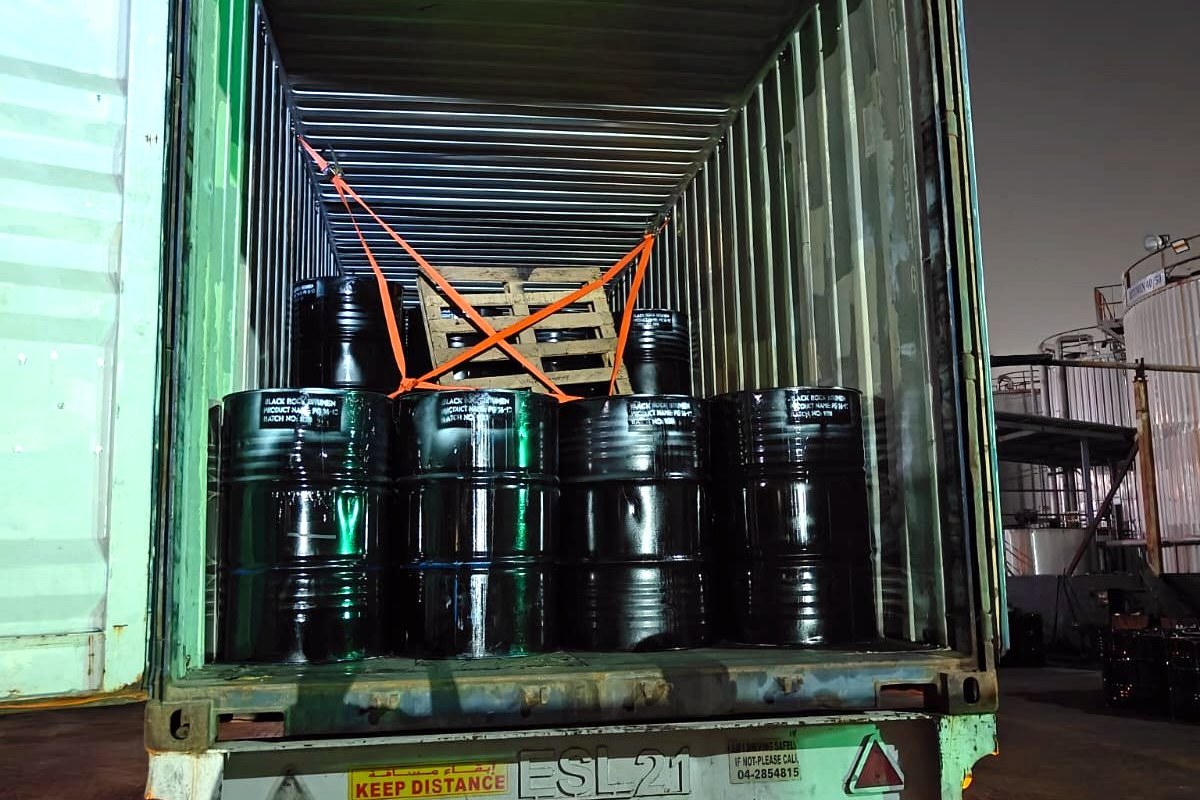
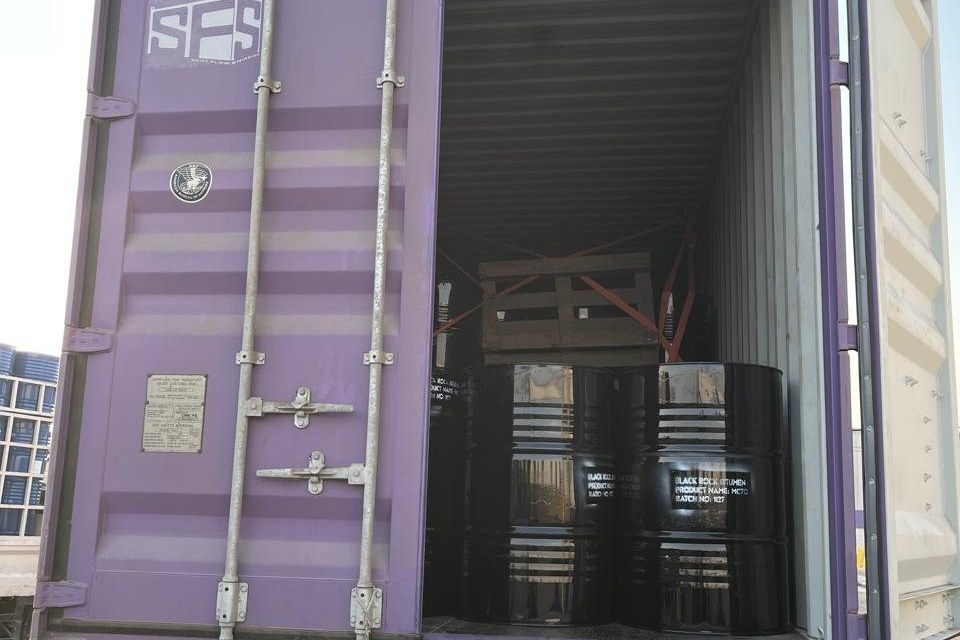
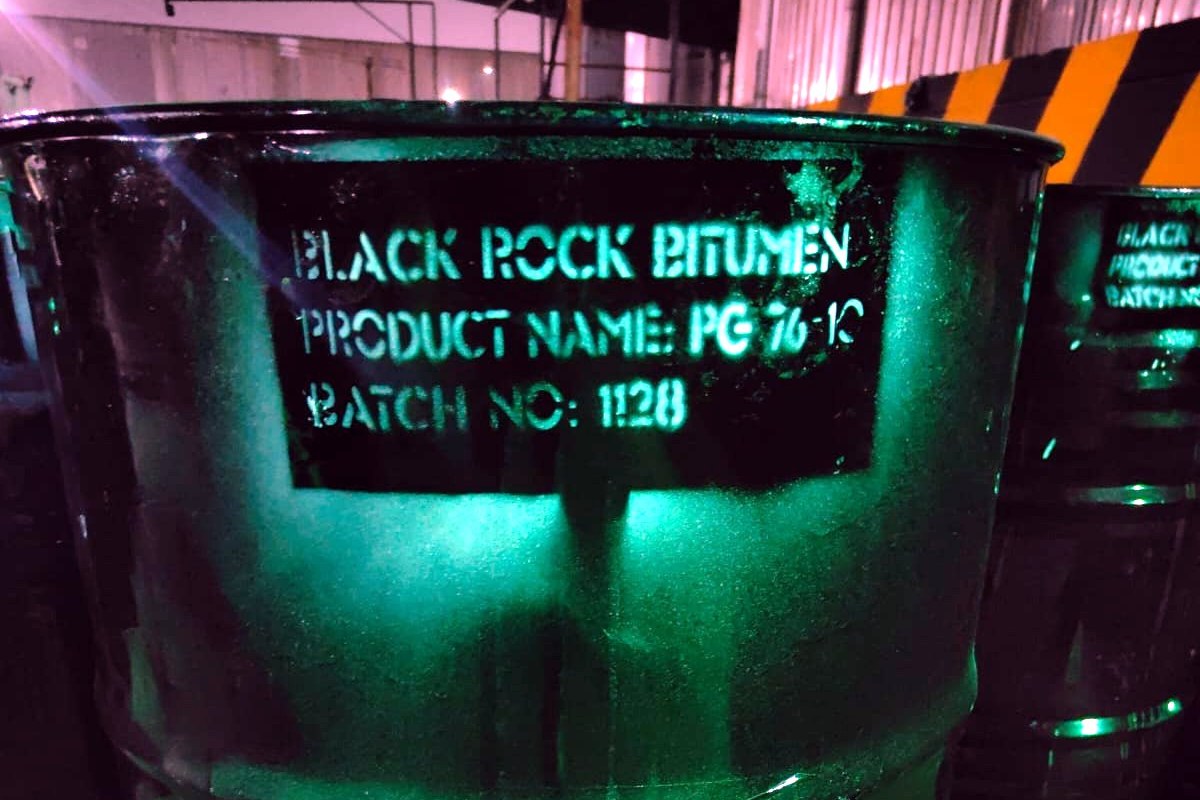
Drummed bitumen is staged at the loading yard, loaded into shipping containers, braced and strapped so the drums cannot shift, and then closed for dispatch to the port. The photos below are from a Black Rock Bitumen PG 76-10 drum shipment and show each stage.
- Staging: filled drums are lined up at the loading yard beside the export containers.
- Loading: drums go into the container upright, in tight rows.
- Securing: timber bracing and lashing straps hold the last rows in place for the sea voyage.
- Dispatch: the container doors are closed and the load leaves for the port.

To compare drums with bulk and bagged options, read how bitumen is packaged and shipped.
Bitumen 60/70 specification PDF, TDS and MSDS
The Bitumen 60/70 MSDS is available to download from the product page, and the technical data sheet is sent on request with a quotation.
Three documents are worth asking any supplier for:
- Technical Data Sheet (TDS): the specification limits the supplier commits to. Here is how to read a bitumen TDS.
- Certificate of Analysis (COA): the actual test results for your batch. Here is how to read a COA line by line.
- Material Safety Data Sheet (MSDS): handling, storage, first aid and fire-fighting information.
Compare the COA against the TDS before you accept a shipment. Every value should sit inside the limits in the specification table above.
For a new supplier, it also helps to know how to test bitumen quality before purchase and which questions to ask a bitumen supplier before placing a bulk order.
What should you check before ordering Bitumen 60/70?
Before you order Bitumen 60/70, confirm six things: the grade named in your project specification, the supplier’s limits, the batch results, the packing, the delivery term and the import paperwork.
- Grade: check that your specification calls for 60/70 and not 50/70 or VG-30. They are close in hardness but certified under different standards.
- TDS limits: every limit on the supplier’s TDS should match the specification table above.
- Batch COA: ask for the Certificate of Analysis for the batch you are buying, and check the batch number on the COA against the number on the drums.
- Packing: choose drums, jumbo bags, Bitutainers or Bitubox to suit how your site unloads and melts bitumen.
- Delivery term: agree FOB, CFR or CIF and name the destination port in the quotation.
- Import documents: use HS code 27132000 and confirm the document list your customs authority needs before the cargo sails.
Related guides: how to buy bitumen from the UAE step by step, the UAE import document checklist, Bitumen 60/70 export from Dubai and 60/70 vs 80/100: which grade to specify.
Frequently asked questions
What is the penetration of Bitumen 60/70?
The penetration of Bitumen 60/70 is 60 to 70 tenths of a millimetre at 25°C, measured with a 100 g needle load applied for 5 seconds under ASTM D5.
What is the softening point of Bitumen 60/70?
The softening point of Bitumen 60/70 supplied by Black Rock Bitumen is 48 to 56°C, measured by the ring and ball method under ASTM D36.
What is the flash point of Bitumen 60/70?
The flash point of Bitumen 60/70 supplied by Black Rock Bitumen is at least 250°C, measured by the Cleveland open cup method under ASTM D92.
Is Bitumen 60/70 the same as VG-30?
No. Bitumen 60/70 and VG-30 are similar in hardness, but 60/70 is graded by penetration at 25°C and VG-30 is graded by viscosity at 60°C. They are tested and certified differently.
Which is harder, Bitumen 60/70 or 80/100?
Bitumen 60/70 is harder. Its lower penetration value means the needle sinks less, so it resists rutting better in hot weather than 80/100.
What is the HS code for Bitumen 60/70?
The HS code for Bitumen 60/70 is 27132000, the heading for petroleum bitumen.
Which standard covers Bitumen 60/70?
Bitumen 60/70 is a penetration grade defined in ASTM D946, the standard specification for penetration-graded asphalt binder used in pavement construction. AASHTO M 20 is the matching AASHTO specification.
How long can Bitumen 60/70 drums be stored?
Black Rock Bitumen uses 12 to 24 months as commercial guidance for bitumen drums that are properly sealed and stored in dry, shaded conditions.
What temperature should Bitumen 60/70 be stored at?
Bitumen 60/70 should be stored at the lowest temperature that still allows safe pumping, typically 140 to 160°C for standard paving grades.
Get a quote for Bitumen 60/70
Black Rock Bitumen supplies penetration grade bitumen, including Bitumen 60/70, from Dubai to contractors and EPC companies across Africa, Asia and the Middle East, with a supply capacity of 50,000 MT per month. Send your quantity, packing and destination port through the contact page and we will reply with a quotation, TDS and MSDS.
About the author:
Saniya Mirza
Content Writer, Black Rock Bitumen
Saniya Mirza writes the Black Rock Bitumen guides on bitumen grades, testing, storage, shipping and supply, in plain language for buyers, contractors and engineers.